
Critical Infrastructure: BAM and Partners Develop AI Assistant for Detecting Material Defects
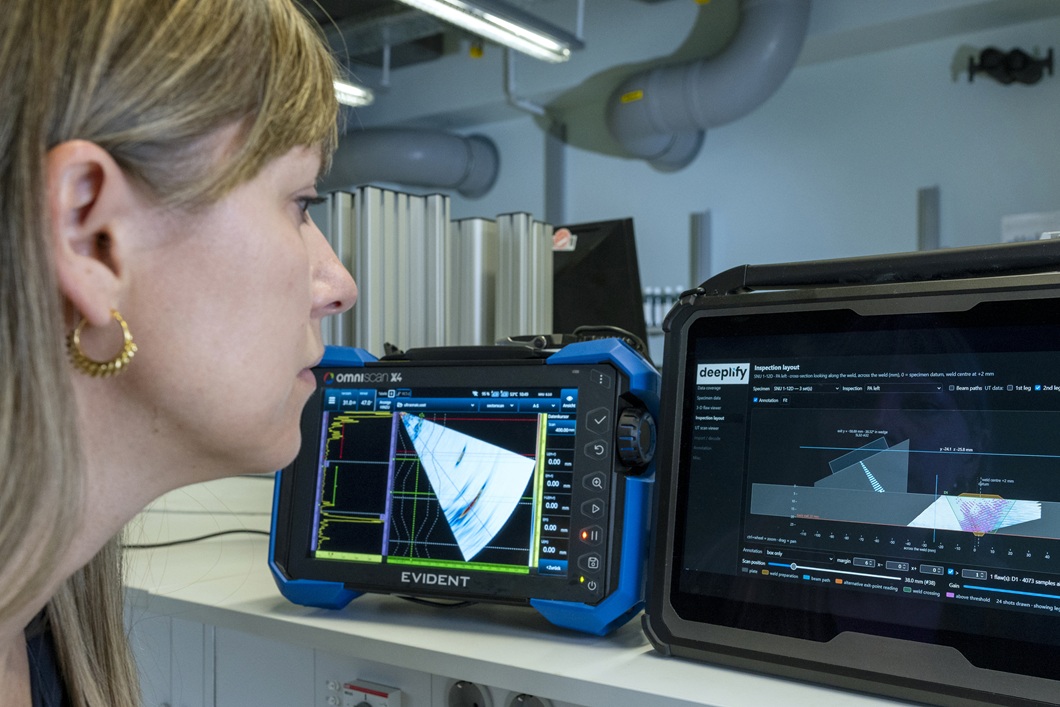
Evaluation of Ultrasound Data on Inspection Equipment and Computers: AI to Support Inspectors in Detecting and Assessing Defects, e.g. in Welds.
The Federal Institute for Materials Research and Testing is developing a human-centered AI-based assistant together with project partners to support inspectors in the detection and assessment of defects in welds. As part of the newly launched research project UltrasonAIc, ultrasonic data will be analyzed using artificial intelligence. The goal is to reduce misclassifications and accelerate inspections, enabling early detection of safety-relevant defects in critical infrastructure and technical installations.
Non-destructive ultrasonic testing can help ensure the safety of critical infrastructure and industrial assets such as bridges, pipelines, and power plants. High-frequency sound waves are transmitted through a material, and the resulting reflections are analyzed. This makes it possible, for example, to detect cracks or inclusions within a component without causing any damage. Test results are used to help assess the condition of assets, plan necessary repairs at an early stage, and reduce the risk of failures and accidents.
However, ongoing digitalization is leading to a significant increase in the amount of data generated during inspections, while the availability of qualified inspection personnel is becoming increasingly limited. This is where the collaborative project UltrasonAIc comes in. In the project, BAM, deeplify GmbH, and DGZfP Ausbildung und Training GmbH are developing an AI-based assistance system designed to support inspectors in the evaluation of large volumes of data. BAM contributes its expertise in ultrasound simulation, reliability assessment, and human-AI collaboration.
“One focus of the project is the realistic simulation of ultrasonic inspections. The resulting data are used to train AI models and enable powerful algorithms even in situations where real inspection data are only available to a limited extent,” says Thomas Heckel, BAM expert in applied ultrasonic testing.
UltrasonAIc combines different ultrasonic testing methods within a single AI model. This approach is intended to improve defect detection accuracy and significantly reduce misclassifications. What makes UltrasonAIc unique is its consistently human-centered approach: the AI serves as an assistance system for inspectors, supporting their work rather than replacing them.
“In safety-critical inspection tasks, AI must not only be powerful but also trustworthy and practical for everyday use. At BAM, we therefore systematically investigate how AI can be designed for non-destructive testing in a human-centered way, ranging from the effective allocation of tasks between humans and AI to usability, transparency, and acceptance by inspection personnel,” explains Marija Bertović, BAM expert in human factors and human-machine interaction.
The technology offers considerable potential, particularly for the energy and hydrogen sectors, the chemical industry, plant and mechanical engineering, and the aerospace industry. In addition to a user-friendly software platform, the project will develop training and continuing education concepts for the use of AI-assisted inspection systems. The training data will be provided in an open format and can be used for further research and development activities. The project results are expected to contribute to increased safety of critical infrastructures while reducing the workload of inspection personnel performing demanding inspection tasks.
The project is coordinated by deeplify GmbH, a German software and AI company based in Düsseldorf that develops AI solutions for asset integrity and industrial inspections, particularly for safety-critical facilities and processes. DGZfP Ausbildung und Training GmbH contributes its expertise in the qualification and training of inspection personnel. In this way, the project brings together AI development, safety research, and professional practice to ensure that the assistance systems operate reliably and can be meaningfully integrated into daily inspection work.
The project is funded under the European Regional Development Fund (ERDF/JTF NRW, funding code EFRE-20801446) for a period of 33 months with approximately €2 million.
UltrasonAIc is embedded within BAM’s fields of activity Plant Safety and Process Engineering and Degradation of Materials. In these fields, BAM develops methods for detecting damage and assessing the safety o