
Veröffentlicht am:
- BAM eigenes Projekt
- Laufend
COMIT - Characterization of moisture and ion transport in porous building materials using NMR and LIBS
Junior research project
-
Projektlaufzeit
01.07.2021 - 31.01.2025
-
Projektart
BAM-eigenes-Projekt
-
Projektstatus
Laufend
Kurzbeschreibung
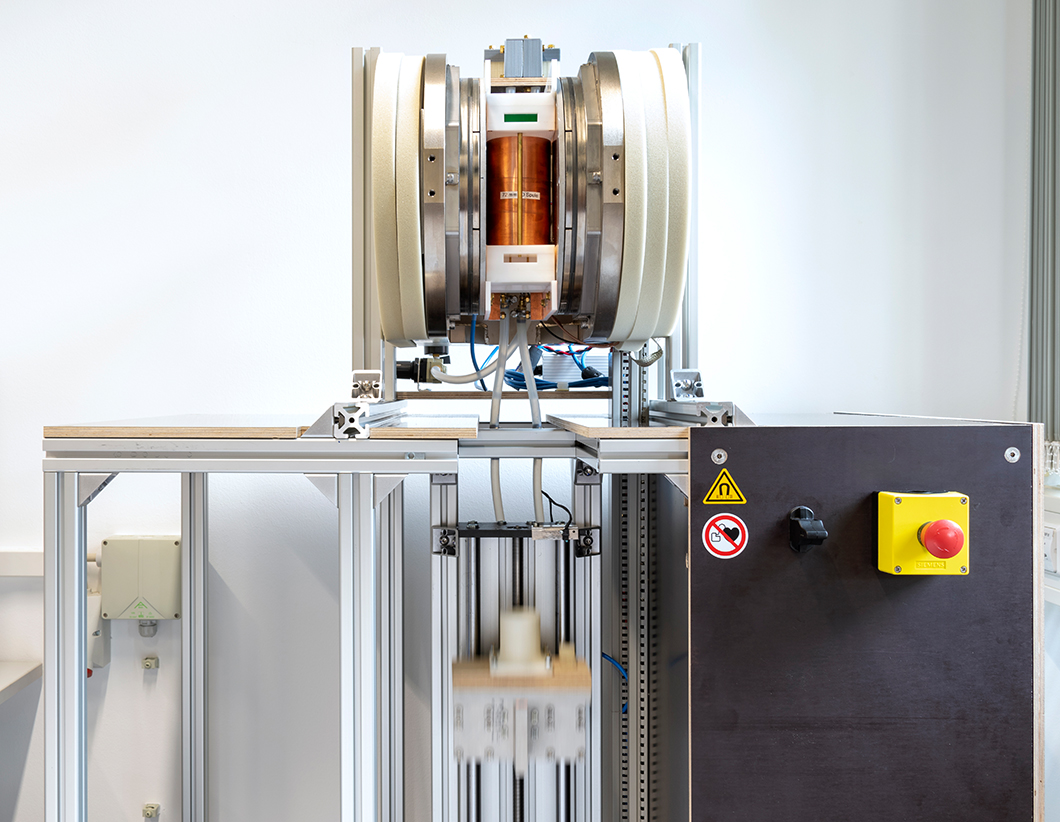
In our work, we use a combination of nuclear magnetic resonance (NMR) and laser-induced breakdown spectroscopy (LIBS) to investigate the transport characteristics of building materials featuring completely different pore systems.
Ort
Bundesanstalt für Materialforschung und -prüfung (BAM)
Unter den Eichen 87
12205 Berlin
Challenge

Building materials before shell of a building
Damage processes in building materials are largely influenced by internal transport processes of water and ions. In order to understand these transport processes, especially in their mutual dependence, the transport behaviour of different materials is investigated. A combination of NMR tomography and LIBS is used to monitor the coupled transport mechanisms. If this approach yields precise and reliable results even allowing to calculate transport coefficients (to be used in probabilistic life cycle assessment models), it could also help to facilitate the development of new, more environment-friendly building materials in the future.
Objectives

Whereas other methods are destructive and therefore cost and time intensive, only focus on one transport process and/or have a very limited resolution, the joint use of NMR and LIBS can be highly effective. These methods are non- or minor-destructive and still yield spatially resolved data. The aim of this work is to establish a reliable approach to study coupled moisture and ion transport processes and derive characteristic transport properties of both typical OPC and new resource-efficient and green cement mixtures.
Partners

Bundesanstalt für Materialforschung und -prüfung (BAM)
Department Non-Destructive Testing
Methods
Different building materials are investigated during capillary suction and rapid migration tests for this project. We include sandstones, cements, mortar and even concretes with recycled aggregates. The samples are sealed with epoxy resin to allow one-directional fluid flow of different sodium chloride brines. The transport of moisture and chloride ions is then measured using NMR and LIBS and the results compared to classical potentiometric laboratory testing.
COMIT - Characterization of moisture and ion transport in porous building materials using NMR and LIBS
Understanding transport processes in building materials is important to characterize their durability and allow for life cycle assessment simulations. Moisture and especially chloride ions are of crucial importance, but it is time-consuming and expensive to determine their transport spatially resolved and in relation to each other. In our work, we use a combination of nuclear magnetic resonance (NMR) and laser-induced breakdown spectroscopy (LIBS) to investigate the transport characteristics of building materials featuring completely different pore systems. Also, we use different pore fluid concentrations and try to determine material specific transport coefficients based on our observations.
We carry out capillary suction and ion migration experiments on CEM I as well as CEM II/A, CEM III/B, CEM II/C and CEM VI or even recycled concrete samples and monitor the moisture uptake by non-destructive, layer sensitive NMR measurements. Subsequently, the samples are split vertically to investigate the chloride ion ingress with high spatially resolved LIBS measurements. This way we can study the material specific transport characteristics of moisture and salt depending on the individual pore-size distributions. The first experiments clearly showed that the two penetration fronts move with different time constants. Moreover, the concentrations of the used solutions play an important role. In the figure is shown that in a mortar sample (max. aggregate size 2 mm) a sodium chloride concentration of 1 mol/l penetrates more slowly than the same fluid with a concentration of 4 mol/l. The moisture fronts seem to penetrate somewhat quicker though, when the ion concentration is lower.

Results of capillary suction experiments using mortar samples and two different sodium-chloride solutions (left: 1 molar NaCl solution; right: 4 molar NaCL solution). The moisture fronts (triangles) are measured with NMR and the chloride fronts (solid lines) with LIBS.
Funding
The HyBeMa project is funded through internal BAM funds.
Kontakt
-

Jun.-Prof. Dr. Sabine Kruschwitz
-

Die BAM ist eine wissenschaftlich-technische Bundesoberbehörde
im Geschäftsbereich des Bundesministeriums für Wirtschaft und Energie.