


A scalable deep learning approach for robust acoustic emission-based damage classification in composite pressure vessels
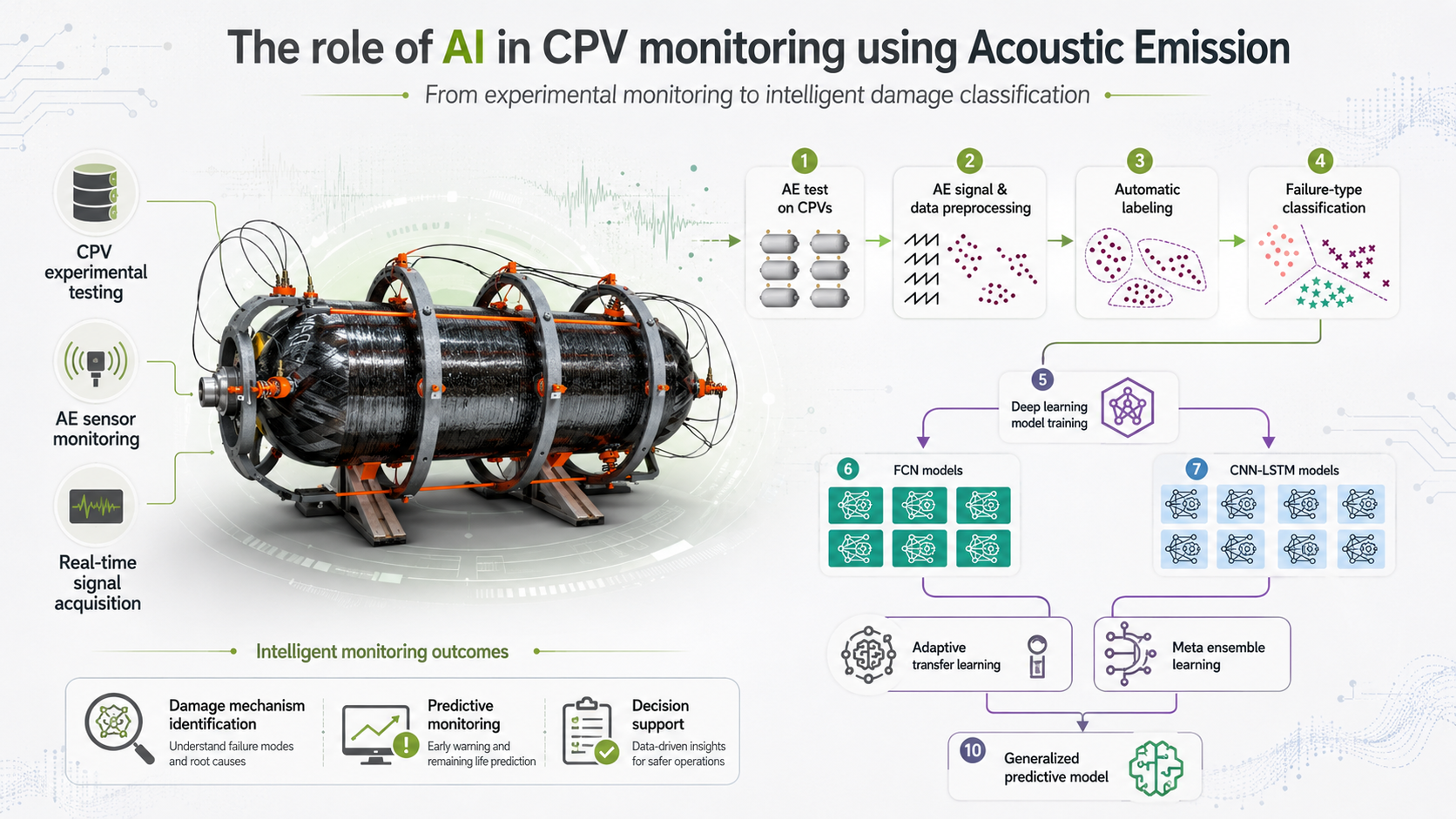
Flussdiagramm der entwickelten Pipeline
Composite pressure vessels (CPVs) are used for the storage and transport of hydrogen under high pressure. They are essential for hydrogen mobility due to their low weight and high storage density. Their operational safety depends on a reliable understanding of damage within the composite structure. The respective damage mechanisms are often difficult to detect using conventional testing methods. In this study, researchers at BAM developed a scalable deep-learning approach for damage classification in fibre-reinforced composite containers based on acoustic emission (AE) measurement data. Acoustic emission testing (AT) is a non-destructive testing method in which elastic waves generated by damage mechanisms in the material are detected by sensors on the surface. However, these signals are particularly influenced by the material’s anisotropic properties, which makes their analysis highly complex.
The proposed approach combines AT with machine learning (ML). The relevant AE features from the CPVs experiments are selected using a genetic algorithm (GA), thereby reducing redundancy. An unsupervised classification method then generates pseudo-labels for the individual damage-related signal classes. These were subsequently used to train two deep learning models. The key innovation of this approach lies in the possibility of generalising the results to CPVs of different sizes and variations. Previous studies often achieved good results with individual datasets, but these could only be applied to a limited extent to new vessel types or test conditions. For this reason, two advanced ML methods for generalisation were employed and compared in order to achieve robust decisions. The best method examined achieved an average prediction accuracy of 99% across all six pressure vessels.
The added value is a scalable deep learning approach for robust damage classification in CPVs based on AE data, with universal applicability across different components. Reliable damage prediction and reliable qualification also enable better design of CPVs, thereby reducing costs, strengthening confidence in hydrogen storage and thus contributing to lower-emission mobility.
A scalable deep learning approach for robust acoustic emission-based damage classification in composite pressure vessels
A. Ghaznavi, E. Duffner, E. D. Kästle, B. Popiela
Results in Engineering (Elsevier), Volume 30, June 2026