


An empirical model for lithium-ion battery fires for CFD applications
, Infrastructure, Department 7
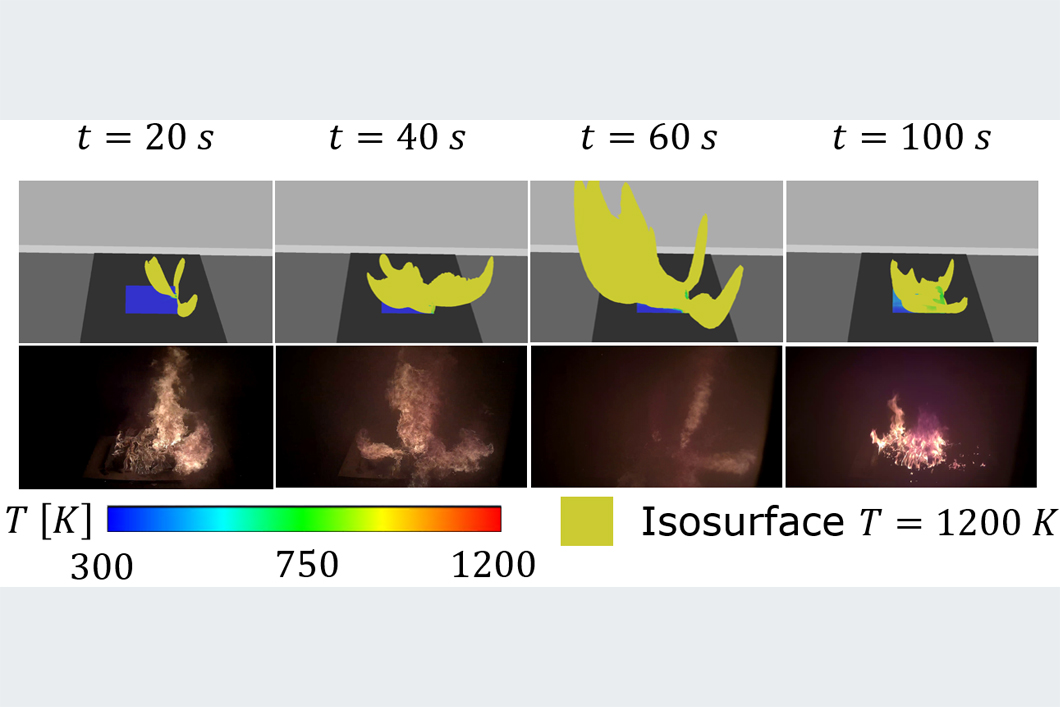
Comparison of simulation and experimental test results of a burning Lithium-Ion Battery.
Lithium-ion batteries (LIB) are used, for example, in the transport and energy sectors. In the event of damage, the thermal runaway of the battery can lead to the battery fire, with characteristics that may differ from traditional hydrocarbon fires.
"Computational Fluid Dynamics" (CFD) is increasingly used as an engineering method in fire protection and not least because of increasing computing capacity. This analysis addresses the question of how the special characteristics of a LIB fire can be accounted for in computational models. For example, the determination of the heat release rate of a LIB via common measurement methods such as the oxygen consumption is subject to uncertainties, and on the other hand, the gases released during a LIB fire can burn as stub flames.
In this paper, an empirical model is presented that determines the heat and gas release in a CFD simulation based on the mechanisms of thermal runaway in the result.
The model was compared with the experimental results by simulating a fire test based on the flame geometry, the temperatures, and the heat release rate. The influence of essential input parameters of the model was examined using a parameter study.
For the investigated battery fire, the heat release rate and flame shape could be predicted qualitatively. However, the calculated temperatures provided deviations from the measured values. The model should be further investigated by further simulations of different tests and battery types.
The validation tests for the simulations took place as part of the research project " Sicherheit in unterirdischen städtischen Verkehrsbereichen bei Einsatz neuer Energieträger " (SUVEREN).
An empirical model for lithium-ion battery fires for CFD applications
Sascha Voigt, Felix Sträubig, A. Kwade, J. Zehfuß, Christian Knaust
published inFire Safety Journal, Volume 135, Pages 1–12.