

Examples for fields of application of metallic glasses and an abstract visualization of x-ray photon correlation spectroscopy.
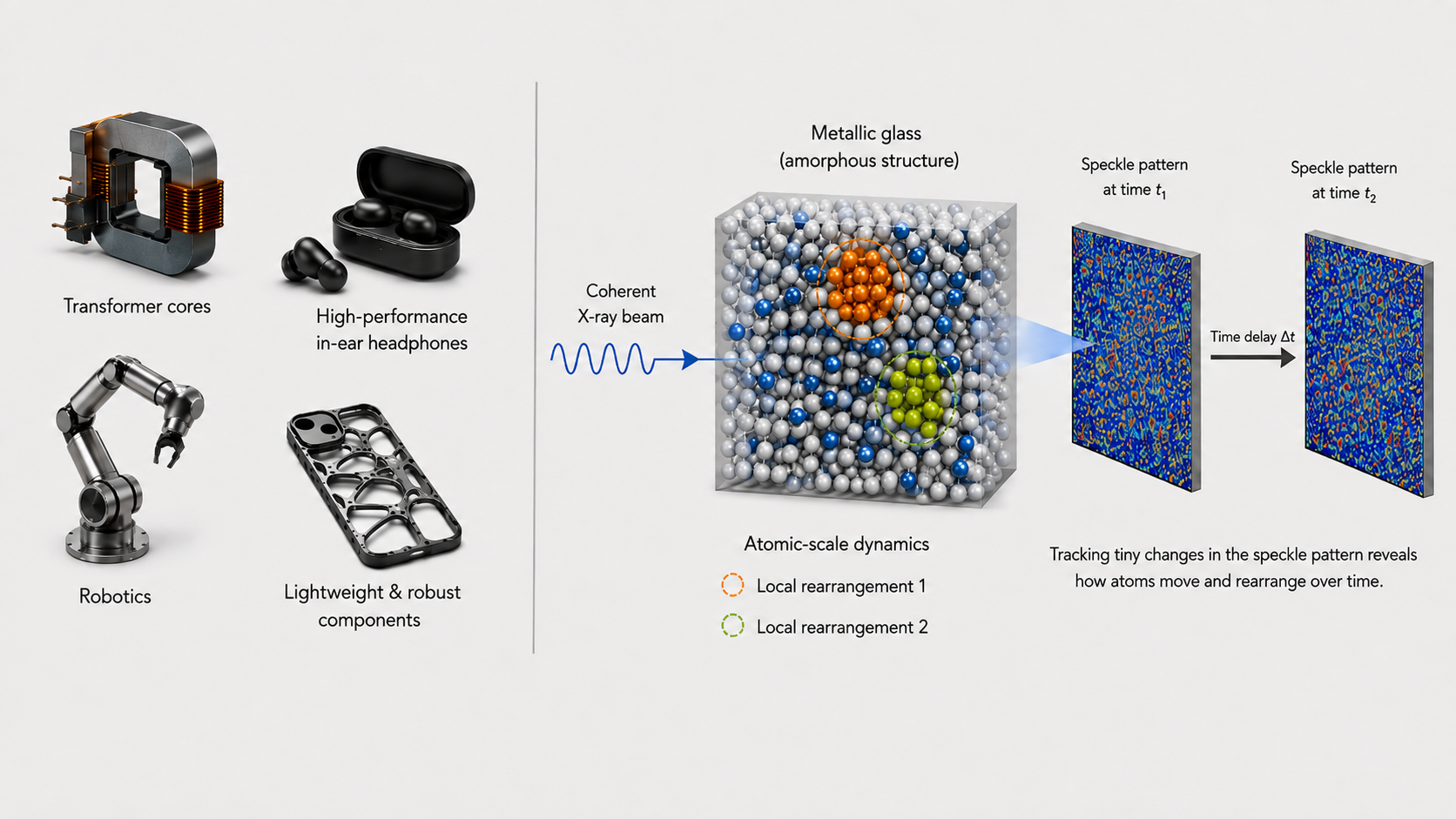
Metallic glasses are metals with an unusual atomic structure: unlike conventional metals, their atoms are not arranged in a regular crystal lattice. This disordered structure gives rise to an attractive combination of properties, including very high strength, a large elastic limit, and depending on composition, excellent corrosion resistance and even functional properties. These characteristics make metallic glasses promising materials for a wide range of technological applications, such as transformer cores, lubricant-free gears, and flexible components in electronic devices. At the same time, their disordered structure presents a particular challenge for materials development: a glass is not in a true equilibrium state. Even though it appears completely solid, its atomic structure continues to evolve over time. Such subtle changes can influence the stability and properties of the material and, consequently, its long-term performance, highlighting the importance of understanding the underlying degradation mechanisms from a material-safety perspective.
Understanding these changes requires more than knowing where the atoms are – we also need to understand how they move and reorganize over time. The article Current and future directions in probing structural dynamics and transport of metallic glasses, with contributions from BAM’s Department of Materials Engineering, discusses how modern x-ray methods are beginning to provide precisely this information.
One particularly powerful technique is x-ray photon correlation spectroscopy (XPCS). A coherent x-ray beam interacting with a metallic glass produces a characteristic speckle pattern on a detector. Although the average structure of the material may appear unchanged, even very small rearrangements of atoms alter the speckle pattern. By following these changes over time, XPCS provides a window into atomic-scale structural dynamics inside the bulk material.
A key point is that experiments and computer simulations need to work together to better understand metallic glasses and ultimately optimize their properties. While experiments reveal when and on which length scales structural changes occur, atomistic simulations help to identify the underlying atomic processes and thus guide the analysis of experimental data or even challenge conventional interpretations. Simulating the x-ray experiment itself provides a direct link between the atomic picture generated by a computer model and what is measured experimentally at the synchrotron beamline.
This combination is becoming increasingly powerful. Brighter synchrotron x-ray sources, faster detectors and improved modelling now make it possible to investigate processes over much wider ranges of time and length scales than before. This opens the prospect of developing a more complete picture of how metallic glasses evolve over time and respond to their environment.
From a materials-development perspective, this is an important step. Being able to characterize not only the structure of an amorphous material, but also how stable that structure is and how it evolves, helps establish links between processing, microscopic dynamics and material performance. Ultimately, this knowledge can support the design of metallic glasses with properties that remain predictable and controllable throughout processing and use.
Current and future directions in probing structural dynamics and transport of metallic glasses
Peter M. Derlet, Birte Riechers & Robert Maaß
MRS Bulletin, 2026