

Comparison of Residual Stress Measurements in 3D-Printed Steel Components Using the Contour Method
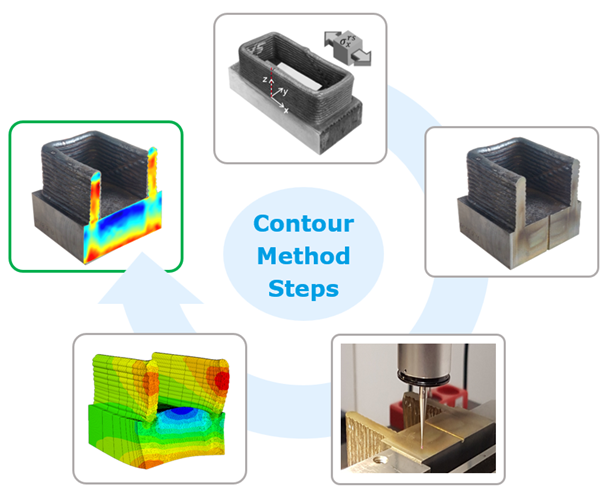
Vom DED-Arc-Bauteil zur Eigenspannungs-Map: Trennen mittels Drahterodieren, Konturmessung und FEM-Auswertung mit der Kontur-Methode.
Lighter and more material-efficient components are widely seen as an important building block for a more climate-friendly industry. Yet additive manufacturing of high-strength using arc welding steel often creates high residual stresses inside the part – stresses that remain locked into the material after production. These hidden loads can distort components, promote cracking and shorten service life. This is exactly what the research team at BAM investigated in an additively manufactured steel component.
At the centre of the study was the contour method. In this approach, the component is precisely cut along a defined plane by wire electrical discharge machining. The tiny deformation released at the cut surfaces is then measured and analysed using the finite element method, a numerical approach for calculating stress fields. This makes it possible to reconstruct how stresses had been distributed inside the component before cutting. The team also used X-ray diffraction for near-surface stresses and neutron diffraction for stresses deeper inside the material.
The result was a consistent overall picture across the different methods. Particularly high tensile stresses were found a few layers below the surface of the additively built steel. By contrast, compressive stresses appeared in the top layers and in parts of the interior. The reason is a complex interplay of intense heating, uneven cooling, shrinkage and microstructural changes in the steel. Hardness measurements supported these findings.
The study shows that residual stresses in such high-performance components can be mapped reliably with methods that are practical and comparatively cost-efficient. This provides an important basis for improving additive manufacturing processes and for designing high-strength steel parts that are safer and more durable in future applications.
Comparative residual stress analysis on a DED-Arc manufactured high-strength steel component using the contour method and XRD
Shabdali, G.A., Wandtke, K., Schroepfer, D. et al.
Weld World, 2026