

How Hydrodynamic Conditions Shape Microbial Degradation in Offshore Wind Structures
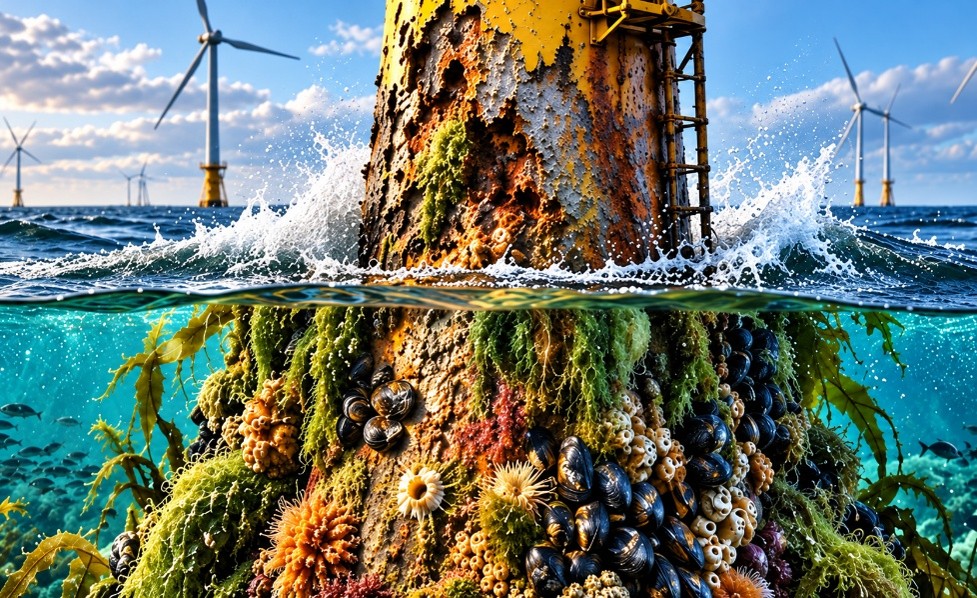
Hydrodynamische Steuerung der mikrobiologisch beeinflussten Korrosion an Fundamenten von Offshore-Windenergieanlagen in mariner Umgebung. Bild mit KI erstellt.
Offshore wind energy is essential for the transition to a low-carbon energy system. However, the long-term safety of offshore wind structures depends on the durability of their steel foundations. In the seabed. These foundations are exposed not only to seawater and sediment, but also to microorganisms, which form biofilms on steel surfaces and can change the local chemistry in ways that accelerate corrosion. This process is called microbiologically influenced corrosion (MIC).
In this study, we investigated how water movement affects MIC under conditions relevant to offshore wind foundations. This is important because the near-seabed environment is not uniform: even small changes in flow can influence how nutrients, sulfide, oxygen, etc., move at the steel surface. Previous studies often compared broad conditions such as stagnant water and turbulent flow. Here, we focused on controlled laminar flow, meaning smooth flow without turbulence, to better understand how subtle hydrodynamic differences shape corrosion processes.
Carbon steel coupons were exposed in a laboratory column system containing microbial communities from North Sea sediment. We combined several types of analysis: metal loss measurements, three-dimensional profiling, microbial community analysis, sulfide measurements. The results show that MIC cannot be predicted from a single indicator such as the presence of sulfate-reducing bacteria or the amount of sulfide in the water. Static conditions produced thicker and more uniform biofilm and corrosion layers, but relatively low and even corrosion. Low laminar flow supported microbial interactions and sulfide accumulation, leading to moderate corrosion. Higher laminar flow reduced the overall sulfide concentration and biofilm thickness, but caused the strongest localized pitting damage.
The societal and environmental value of this work lies in improving the reliability and lifetime assessment of offshore wind infrastructure. Better prediction of corrosion damage can support safer operation, more targeted inspection, and more sustainable maintenance decisions, helping to avoid both premature replacement and unexpected failure.
BAM’s role is to connect materials testing, microbiology, corrosion science, and application-oriented safety research. In the future, laboratory findings like these should be combined with field exposure data, electrochemical monitoring, and predictive models to improve standards and decision-making tools for offshore infrastructure. The study also provides analytical value by showing how corrosion damage emerges from the combined effects of flow, biofilm structure, chemical gradients, and steel surface reactions.