

Interplay between residual stress and microstructure in additive manufacturing
, Materials, Additive manufacturing, Department 8, Department 9, Division 8.5, Division 9.4
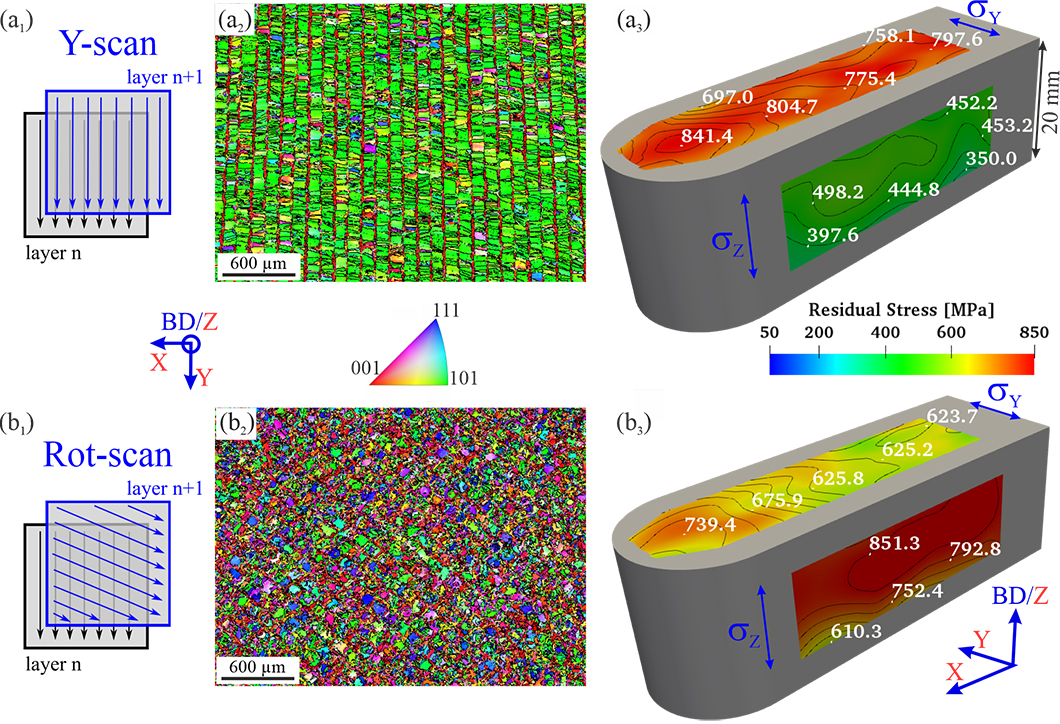
Effect of two different scan strategies (a and b) on the development of microstructure and residual stress.
Additive manufacturing (AM), commonly known as 3D printing, has received significant research focus over the last few years, both in academia and industry. AM refers to a family of layer-upon-layer processing techniques enabling the production of metallic components with a degree of complexity unchallenged by conventional techniques (e.g., machining). In fact, AM offers ample opportunities to tailor the microstructure by tuning process parameters such as the scan strategy. Nevertheless, the localized melting and rapid cooling associated with AM generate large and complex residual stress (RS). These RS can impact the integrity of parts when they are not correctly understood and mitigated. In this regard, the choice of scan strategy is also used as a method for RS reduction. Unidirectional scanning (Y-scan, a1) generates a columnar and textured microstructure (see a2). 67°-rotation (Rot-scan, b1) between subsequent layers is expected to homogenise the distribution of thermal flux and stress, reducing the texture level and size of columnar grains (b2), as well as the amount of RS. This is the tendency observed on the top surface of the investigated specimens (a3 and b3), where the in-plane σY is larger (ΔσY ≈ 100 MPa) in the Y-scan specimen. However, the tendency is inversed on the lateral surface, where the Y-scan specimen exhibits significantly lower σZ (ΔσZ ≈ 400 MPa). We attribute this behaviour to the fact that the Y-scan microstructure has a higher capacity along the building direction, BD/Z-axis to transform part of the thermal stress into plastic strain (in the form of dislocation accumulation) reducing the magnitude of RS. This work paves the way to further in-depth understanding of the processing–microstructure/RS–property relationship, which is fundamental for the maturing of AM techniques.
The residual stress in as‑built Laser Powder Bed Fusion IN718 alloy as a consequence of the scanning strategy induced microstructure
Itziar Serrano-Munoz, Tatiana Mishurova, Tobias Thiede, Maximilian Sprengel, Arne Kromm, Naresh Nadammal, Gert Nolze, Romeo Romeo Saliwan‑Neumann, Alexander Evans, Giovanni Bruno
published in Scientific reports, Vol. 10, issue 1, page 14645 , 2020
BAM, division Micro Non-Destructive Testing and division Weld Mechanics