
Beyond colour: resolving oxidation fronts in slag-containing cements by Mn K-edge XANES
Bestimmung der Oxidationsfront in CEM III/B mittels ortsaufgelöster Mn-K-Kanten-XANES-Spektroskopie
Ground granulated blast furnace slag (GGBFS) is widely used as a cement constituent and as a precursor for alkali-activated materials. Beyond its contribution to lower-carbon binders, GGBFS creates strongly reducing conditions in cementitious materials, with important consequences for reinforcement corrosion and other durability-related processes. When exposed to air, these materials typically change color from blue-green to white, and this color change is commonly interpreted as an oxidation front. But does the visible front really show how far oxidation has progressed?
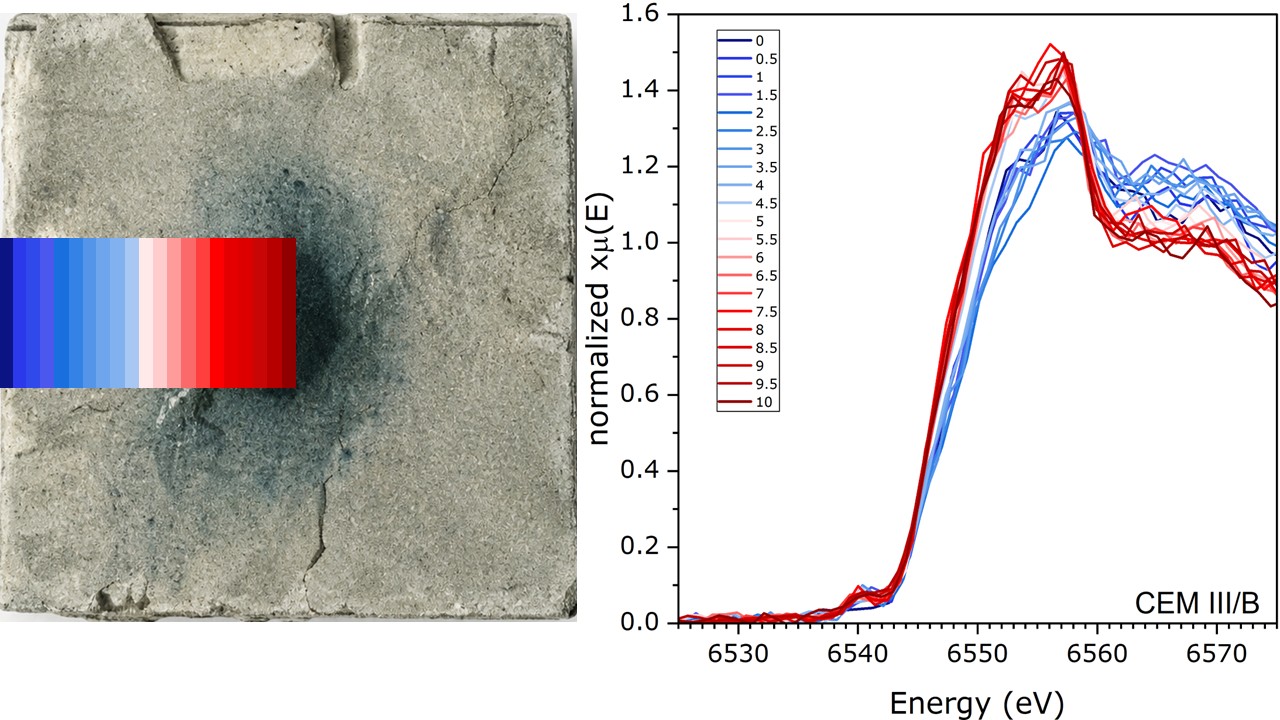
This study addresses this question using a spatially resolved Mn K-edge X-ray absorption near-edge structure (XANES) to directly track the progress of oxidation inside slag-containing cement pastes. Manganese provides a particularly powerful redox indicator. Reduced sulfur species oxidize rapidly upon exposure to air, whereas Mn oxidizes more slowly, and its XANES edge position sensitively reflects its oxidation state. Persistent Mn oxidation occurs only after the reduced sulfur species have been fully oxidized. A blast furnace cement (CEM III/B), an alkali-activated slag (S100), and an alkali-activated calcined clay-GGBFS blend (C40S60) were investigated. Measurements at the BAMline at BESSY II enabled spatial oxidation profiles to be obtained from the exposed surface towards the center of the samples.
The results reveal a fundamental limitation of relying solely on color change. For CEM III/B, Mn oxidation extended to approximately 4 mm, while the gradual color transition prevented a precise visual determination. The discrepancy was even more striking for S100: a distinct color-change front was visible at approximately 1.5-2 mm, yet XANES detected no Mn oxidation even at the sample edge. The brighter region therefore indicated partial sulfur oxidation rather than complete oxidation. Conversely, in the heterogeneous C40S60 paste, where no clear visual front could be identified, XANES indicated incipient Mn oxidation within the outer approximately 2.5 mm.
Thus, Mn K-edge XANES spectroscopy can reveal oxidation fronts that visual inspection may misidentify or fail to detect altogether. By providing spatially resolved insight into the redox state of slag-containing binders, the approach goes beyond conventional colour-based assessment and offers a new route to investigate oxidation processes relevant to the long-term durability and corrosion behavior of low-carbon cementitious materials.
Determination of the oxidation depths of ground granulated blast furnace slag-containing cement pastes using Mn K-edge X-ray absorption near-edge structure spectroscopy
Luís U. D. Tambara Jr., Ali Nikoonasab, Martin Radtke, Ana Guilherme Buzanich, Gregor J. G. Gluth.
Journal of the American Ceramic Society, 2026