

Microstructural investigations on the role of the manufacturing-induced cellular structure in laser-powder-bed-fused stainless steel 316L during cyclic plastic deformation.
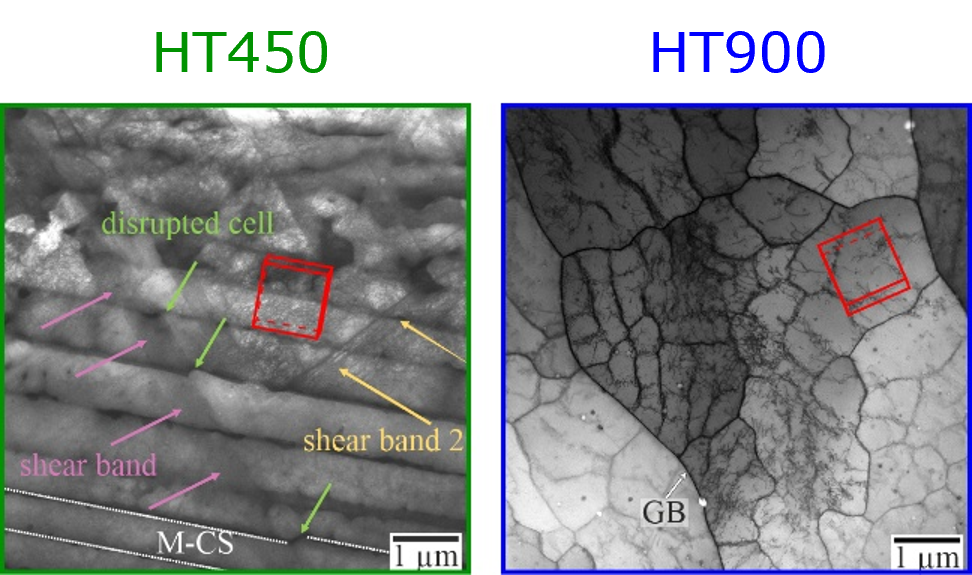
TEM analysis on 0° foil from specimens heat-treated at different temperatures and run to failure in Incremental Step Test (IST): Comparison between the deformation behavior.
Additively manufactured (AM) austenitic stainless steel 316L produced by Laser Powder Bed Fusion (PBF-LB) has shown superior tensile properties compared to its wrought counterpart (i.e., increased yield strength with little loss in ductility). Reasons for this improvement were found in its hierarchical microstructure: manufacturing-induced cylindrical cellular structures (M-CS) with a polygonal cross section and a diameter in the range of one micrometer are present. Such M-CS form due to rapid solidification and extend in ⟨100⟩ in the case of cubic crystal systems, e.g., the face centered cubic (FCC) lattice of 316L. The M-C boundaries contain elemental segregations (for 316L, Cr, Mn, and Mo) and a high density of tangled dislocations. Also, nanoparticles (transition-metal-rich silicates, 10 nm – 150 nm in size) are usually found in these regions. Beside grain boundary strengthening, particle strengthening, and chemical segregation, the high dislocation density at cell walls as well as their inhomogeneous distribution within them are found to be major strengthening mechanisms.
While several studies relate tensile properties with the microstructural features in PBF-LB/316L, only a few studies are reported on the cyclic plastic deformation behavior and microstructural evolution. Therefore, the room temperature cyclic plastic deformation behavior of PBF-LB stainless steel 316L, as heat treated to two microstructural states, was investigated after room temperature strain-controlled low-cycle fatigue tests. The lower temperature heat treatment (450°C/4 hours) retains the cellular structure present in an as-built material. In contrast, the higher temperature heat treatment (450°C/4 hours followed by 900°C/1 hour) is associated with the dissolution of the manufacturing-induced cellular structure (M-CS) whilst maintaining similar grain and subgrain morphology and texture, consequently leading to decreased static yield strength. The two different microstructures were tested under cyclic loading as a function of strain amplitude. This was followed by detailed electron microscopy studies to understand the cyclic deformation mechanisms. While both material conditions exhibited distinct cyclic softening after a short initial hardening phase, removing the M-CS induced a less pronounced subsequent degree of relative softening.
It was demonstrated that the ability of this microstructural feature to act as barrier against plastic deformation when cyclically strained is degraded, which is reflected in the strong reduction of the cyclic yield strength.