

New Findings to Improve the Safety of Tanks for Cryogenic Liquefied Gases
, Energy
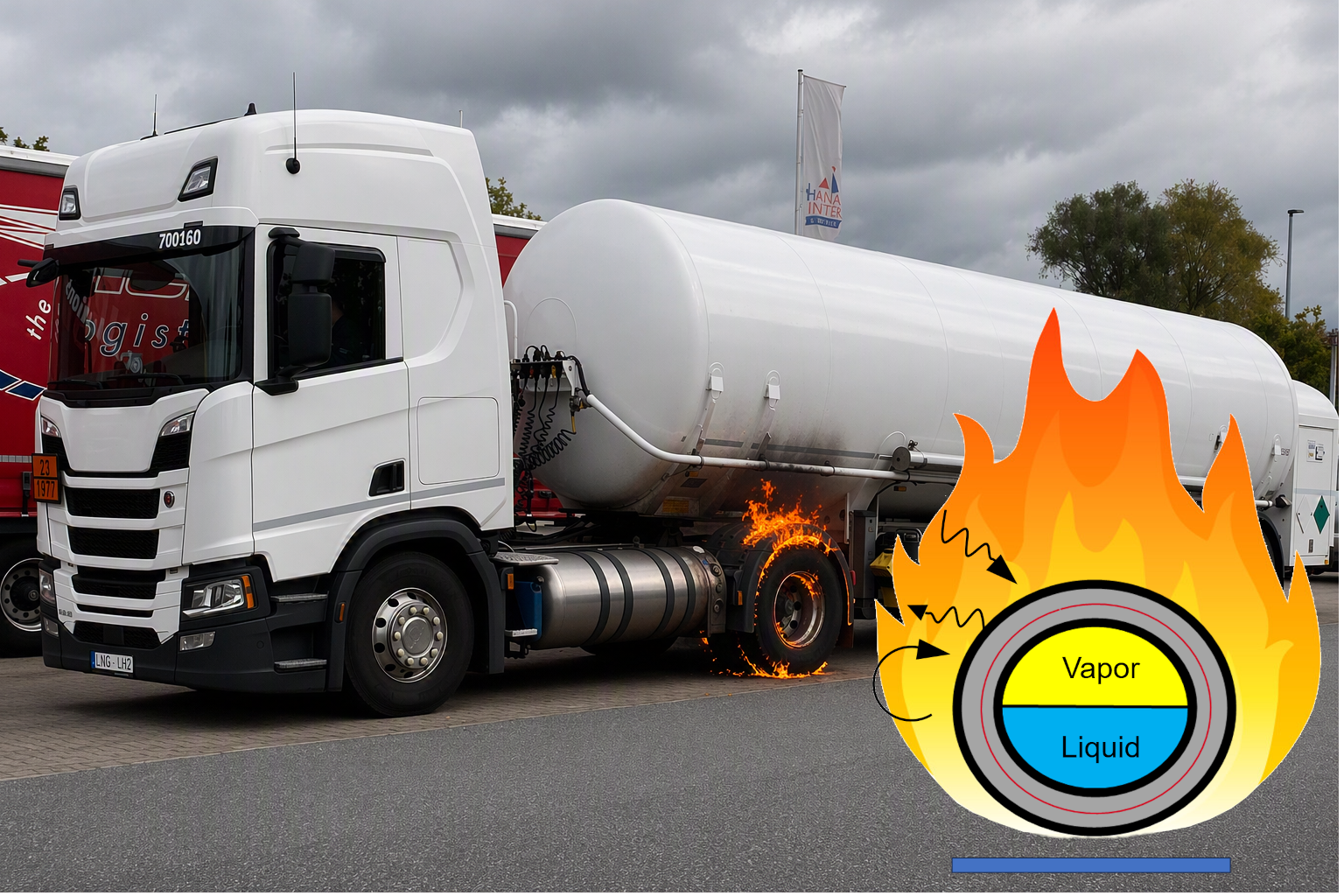
Schwerlastfahrzeug mit kryogen verflüssigtem Kraftstoff und Transportgut mit einem Reifenbrand
Hydrogen and natural gas can be efficiently transported and used as fuels when stored in a cryogenic liquefied state. This requires temperatures up to minus 253°C, which must be maintained over several days. This is achieved using cryo-tanks whose design is similar to that of a vacuum flask. This storage technology differs significantly from conventional tanks for fuel and transport tanks. This raises the question of whether existing safety standards—for example, in the event of a fire—are applicable or need to be revised.
The cryo-tanks consist of an inner and an outer wall with highly efficient thermal insulation in between. This insulation maintains the low temperatures of the stored materials over time. In the event of a fire, however, the insulation can be damaged. This allows more heat to enter the tank, which can lead to a rapid increase in pressure and, in extreme cases, to tank failure. The safety of a cryogenic tank and its insulation depend not only on the heat flux from a fire into the tank, but also on factors such as the duration of the fire, flame temperature, and soot formation. These factors have not been adequately taken into account in previous test procedures.
Researchers at the Federal Institute for Materials Research and Testing (BAM) and the University of Bologna in Italy have therefore conducted extensive fire tests and analytical investigations. Accident scenarios were simulated at BAM’s Test Site Technical Safety. Of particular relevance were fires involving spilled fuel, tires, and vehicle cabins. The studies showed that the test conditions used today often underestimate the stresses caused by real fires.
Based on the results, the researchers developed a testing procedure that is easy to replicate and to apply. This will allow the safety of cryogenic tanks to be tested under more realistic conditions in the future. It enables the development of safe, efficient tanks, and helps prevent severe accidents that could damage people, infrastructure, and emergency responders. At the same time, robust safety evidence strengthens confidence in climate-friendly energy sources such as hydrogen and supports their safe use in transportation and logistics.
These findings are also of great significance to experts in the field. For the first time, the study provides an experimentally validated basis for uniform safety standards in approval procedures. As a result, future regulations could be better adapted to real-world fire incidents.
Kryo-Tanks bestehen aus einer Innen- und Außenwand mit einer hocheffizienten Wärmedämmung dazwischen. Diese hält die niedrigen Temperaturen der gelagerten Stoffe über Tage aufrecht. Im Brandfall kann die Dämmung jedoch geschädigt werden. Dadurch gelangt mehr Wärme in den Tank, was zu einem schnellen Druckanstieg und im Extremfall zu einem Versagen des Behälters führen kann. Die Sicherheit eines Kryo-Tanks und dessen Isolation hängen nicht nur vom Wärmestrom von einem Feuer in den Tank ab, sondern auch von Faktoren wie Branddauer, Flammentemperatur und Rußbildung. Dies ist in bisherigen Prüfverfahren nur unzureichend berücksichtigt worden.
Forschende der Bundesanstalt für Materialforschung und -prüfung (BAM) und der Universität Bologna in Italien haben deshalb umfangreiche Brandversuche und Berechnungen durchgeführt. Auf dem BAM Testgelände Technische Sicherheit wurden Unfallszenarien nachgestellt. Besonders relevant waren Brände von ausgelaufenem Kraftstoff, Reifen und Fahrzeugkabinen. Die Untersuchungen zeigten, dass die heute verwendeten Prüfbedingungen die Belastung durch reale Brände häufig unterschätzen.
Auf Grundlage der Ergebnisse entwickelten die Forschenden ein reproduzierbares und fehlerfrei anwendbares Prüfverfahren. Damit kann die Sicherheit der Kryo-Tanks zukünftig unter realistischeren Bedingungen getestet werden. Dies ermöglicht die Entwicklung sicherer, leistungsfähigerer Tanks und hilft, schwere Unfälle mit Gefahren für Menschen, Infrastruktur und Einsatzkräfte zu vermeiden. Gleichzeitig stärken belastbare Sicherheitsnachweise das Vertrauen in klimafreundliche Energieträger wie Wasserstoff und unterstützen deren sicheren Einsatz im Verkehr sowie beim Transport.
Auch für die Fachwelt sind die Erkenntnisse von großer Bedeutung. Die Studie liefert erstmals eine experimentell abgesicherte Grundlage für einheitliche Sicherheitsstandards für Zulassungsverfahren. Künftige Vorschriften könnten dadurch besser an reale Brandereignisse angepasst werden.