

Quantification of light elements in advanced materials such as graphene oxide using energy-dispersive X-ray spectroscopy (EDS) for reliable quality assurance, particularly in small and medium-sized enterprises (SMEs)
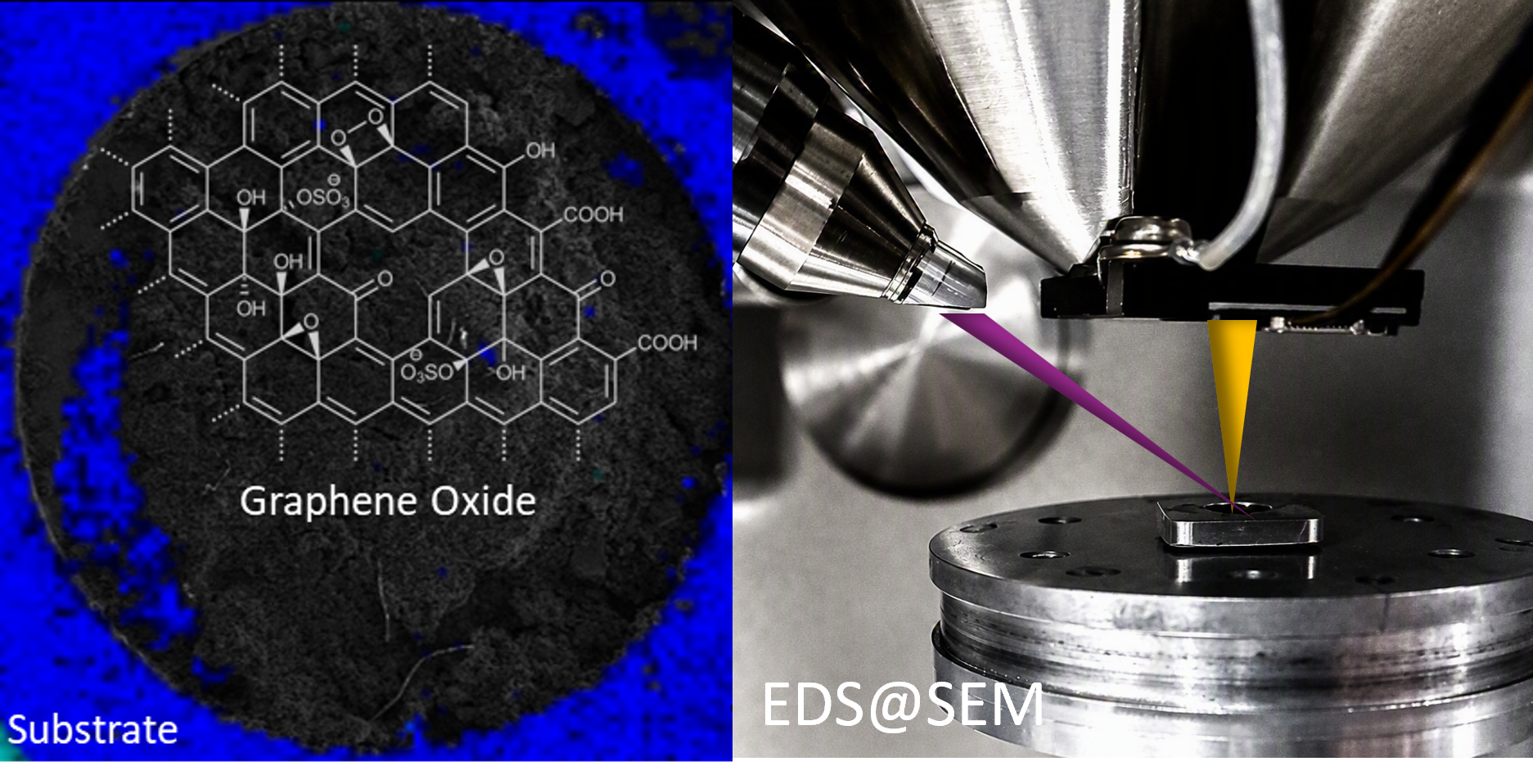
Structure of Graphene oxide : This image of a simple structural formula is ineligible for copyright and therefore in the public domain, because it consists entirely of information that is common property and contains no original authorship. All other images were created by BAM.
Advanced materials are regarded as essential for “strengthening European competitiveness, achieving Europe’s strategic autonomy, and implementing the Green Deal”].1 The reliable characterization of these materials is a prerequisite for their development and commercialization, with elemental composition being one of the most important parameters. A particular challenge in this context is the analysis of light elements such as carbon, oxygen, nitrogen, and fluorine.
These light elements are predominantly found in carbon-based advanced materials, including graphene-related two-dimensional (2D) materials. This class of materials consists of only a few atomic layers and exhibits outstanding electrical, optical, and mechanical properties. Consequently, numerous applications are being explored in key future technologies such as optoelectronics, sensing, and energy storage, as well as in more established fields, for example as additives in paints, or as components of composite materials used in vehicles, aircraft, and wind turbines.
Until now, X-ray photoelectron spectroscopy (XPS) has generally been recommended as the method of choice for elemental analysis of such materials. However, this technique requires sophisticated and therefore expensive instrumentation, as well as a high level of expertise. As a result, such analyses can typically only be performed in highly specialized testing laboratories.
In a recent publication, BAM demonstrated that light elements can also be quantified using energy-dispersive X-ray spectroscopy (EDS), a technique that is commonly available on scanning electron microscopes and is traditionally used for the analysis of heavier elements, primarily metals. Technological progess over recent years have led to increasingly compact and affordable instruments, resulting in the widespread adoption of EDS even in smaller laboratories for routine quality control.
With the workflow developed by BAM, small and medium-sized enterprises can reliably perform quantitative elemental analysis of graphene and related 2D materials, thereby ensuring the quality and safety of their products. Such companies, many of them start-ups, play a key role in shaping the market for graphene and other advanced materials, particularly during the early stages of commercialization. The development of practical analytical workflows such as this strengthens their market position and supports the broader adoption of advanced materials technologies.
Standardized Elemental Composition Analysis of Graphene-Related 2D Materials (GR2M) With SEM/EDS and XPS Works Reliably
Paul Mrkwitschka, Mario Sahre, Elena Corrao, Francesco Pellegrino, Beatriz Alonso, Amaia Zurutuza, Jörg Radnik, Vasile-Dan Hodoroaba
Small: Volume 22, Issue 25