


Interlayer Bonding in 3D Concrete Printing – A Look Between the Layers
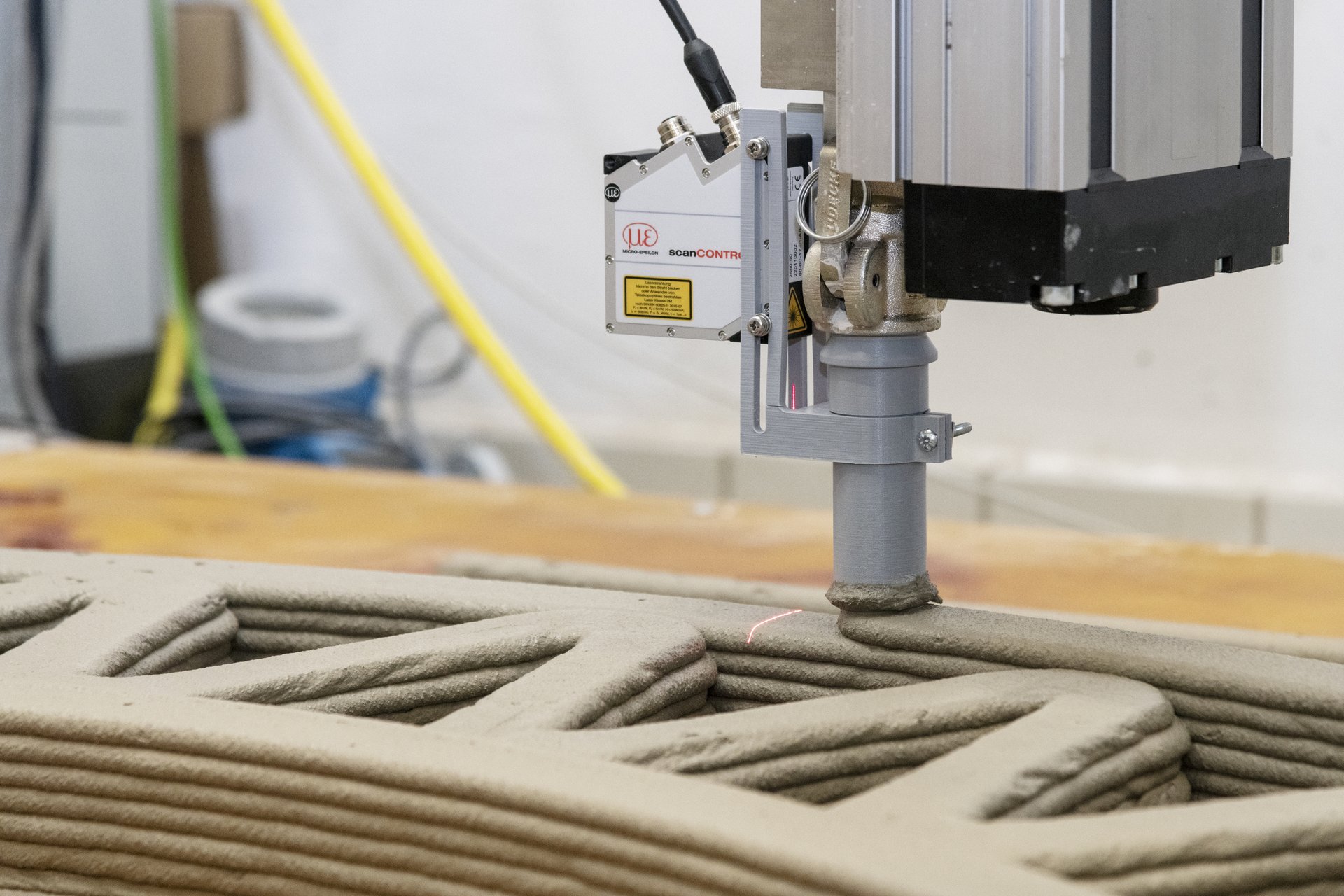
Just before application of a new layer in 3D concrete printing, the surface is inspected by a laser profile scanner.
3D concrete printing holds great potential for automation in the construction industry, offers a high degree of geometric freedom in design, and enables lightweight construction. However, this brings new challenges in process and quality control. Due to the layer-by-layer manufacturing process, there is a risk of insufficient bonding between the individual layers. To meet the demand for safety in technology and chemistry, new inspection methods must be developed and integrated into the automated process.
The implementation of laser profile scanners in the printing process is a widely used approach for capturing geometry, surface roughness, and layer thicknesses. In this method, a laser line is projected onto the surface, and the reflection is captured by means of an image sensor. The distance of a point on the line is calculated by evaluating the position of the reflection. The intensity of the reflected laser line, which some systems can provide as an additional parameter, has so far remained largely unused in concrete printing. The reflection intensity depends on the properties of the reflecting medium. Since the profile scanners operate in the visible spectrum, optically perceptible differences can be digitised in this way. If the material properties change – for example due to variations in surface moisture or progressive hydration – the reflection intensity changes simultaneously.
In the study conducted, the various influences on the reflection intensity were systematically investigated. For this purpose, several specimens made of cement paste were prepared to isolate the effects of surface temperature, surface moisture, and the progressive hydration of the cement. Surface moisture and hydration were identified as the dominant factors influencing reflection intensity, both of which also affect the quality of the interlayer bond. Thus, the reflection intensity of a laser profile scanner offers the potential for in-situ measurements, capturing the surface immediately before the deposition of a new layer and detecting potential weak points in the interlayer bond.
Influences of Surface Properties on the Reflection Intensity - Towards in Situ Monitoring During Early Age Hydration of CEM I
Eric Schönsee, Götz Hüsken, Amarteja Kocherla, Christoph Strangfeld
Journal of Nondestructive Evaluation, 2026