
BAM Coordinates European Research Project for Sustainable and Safe Automotive Steels
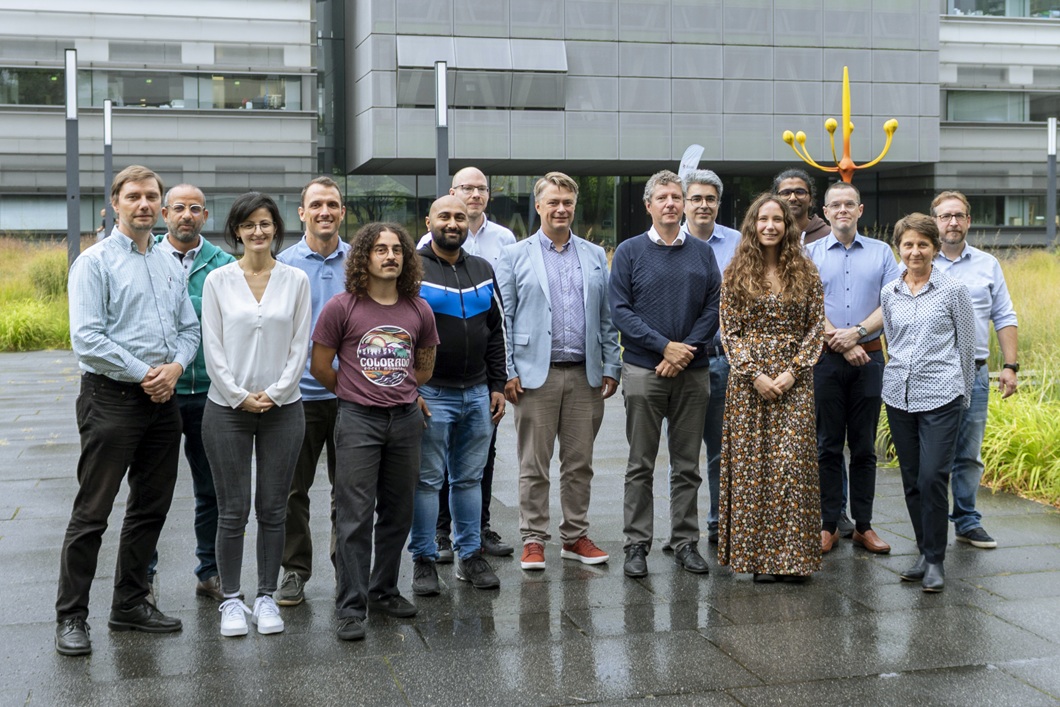
Kick-off Meeting for the Hydro-QP Project at BAM.
How can modern automotive steels be produced in a more climate-friendly way without compromising safety and reliability? This is the question being addressed by the European research project HYDRO-QP, coordinated by the Federal Institute for Materials Research and Testing (BAM), which officially launched today. Researchers from industry and academia in four countries are investigating how hydrogen and recycling-related impurities affect the performance of modern high-strength steels.
The steel industry faces a dual challenge: to reduce its CO₂ emissions, it must significantly increase the use of recycled steel. At the same time, the demands placed on modern materials continue to grow. High-strength steels used in automotive body structures, for example, must combine excellent formability, strength, and long-term reliability.
However, recycling can introduce unwanted residual elements such as tin or copper into the material. Their impact on steels used in particularly demanding applications remains insufficiently understood. One such application involves so-called quench-and-partitioning (Q&P) steels, which are at the center of the HYDRO-QP project. These materials belong to the most advanced generation of high-strength steels and are increasingly being used in safety-critical automotive components. Owing to their combination of high strength and good formability, they enable lighter vehicle structures and thus contribute to improved energy and resource efficiency. At the same time, these steels are susceptible to hydrogen, which can enter the material during manufacturing or service. Even small amounts of hydrogen may promote crack formation and reduce component lifetime.
“If we want to increase the use of recycled steel in the future, we need to understand how hydrogen and recycling-related impurities affect modern high-performance steels. Digital methods and artificial intelligence help us unravel these complex interactions more quickly and accurately,” says project coordinator Tilmann Hickel of BAM.
A special focus of HYDRO-QP is on digital materials research. The project combines experimental materials science with data-driven simulation approaches and machine learning methods.
Researchers will produce model steels containing different levels of recycling-related residual elements and analyze their deformation behavior under the influence of hydrogen. The investigations will employ high-resolution microscopy techniques, X-ray analysis, and mechanical testing. These studies will be complemented by multiscale simulations that provide insights down to the atomic scale. The resulting data will be incorporated into digital models designed to accelerate the development of new materials and improve the prediction of their properties.
BAM contributes its expertise in materials informatics and materials design, data-driven materials development, materials simulations, and the analysis of degradation mechanisms. In addition, the hydrogen Competence center H2Safety@BAM is involved in the project. HYDRO-QP aligns closely with BAM’s recently outlined materials strategy, which aims to make high-performance materials more robust, sustainable, and safe.
The project results may help increase the share of recycled material in demanding steel applications. At the same time, they will provide the scientific foundation for new, more resilient steels and digital tools capable of predicting their properties. This could enable European steel manufacturers to produce more sustainably while strengthening their competitiveness. HYDRO-QP therefore contributes to resource-efficient steel production, climate-friendly value chains, and the competitiveness of the European steel industry.
The project is coordinated by BAM and brings together the companies thyssenkrupp Steel Europe, voestalpine Stahl, and ArcelorMittal Maizières Research, as well as Materials Center Leoben, Ghent University, and the Leibniz Institute for Materials-Oriented Technologies (IWT Bremen). Running until February 2030, the project is funded by the European Union under the Research Fund for Coal and Steel (RFCS) with a total budget of €1.8 million.