

Description
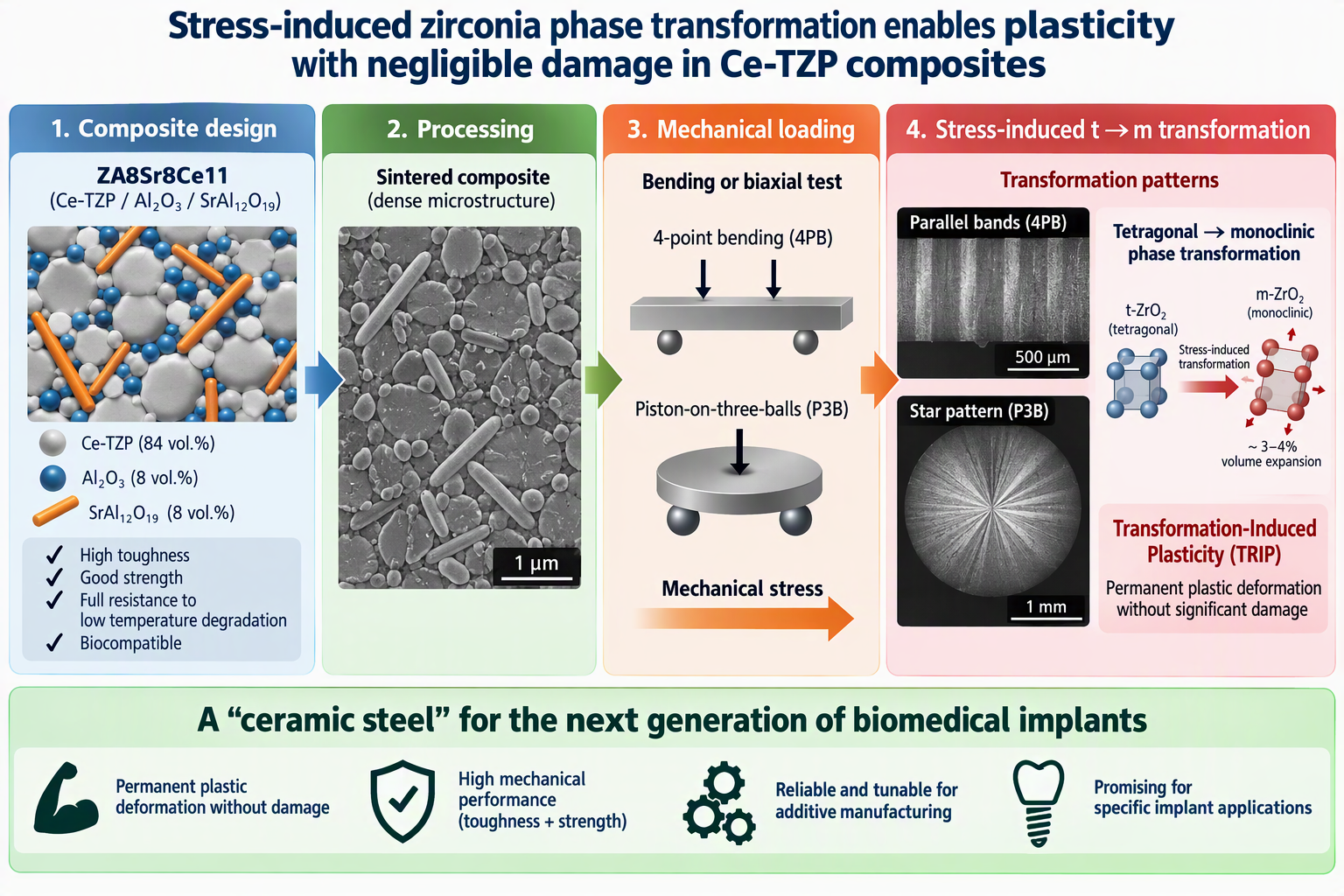
The ImPatienCe project investigates ductile ceria-stabilized zirconia composites for 3D-printed, patient-specific applications. This project combines synchrotron X-ray techniques to examine stress-induced transformation bands and microcrack formation to relate microstructural differences with performance.
Challenge
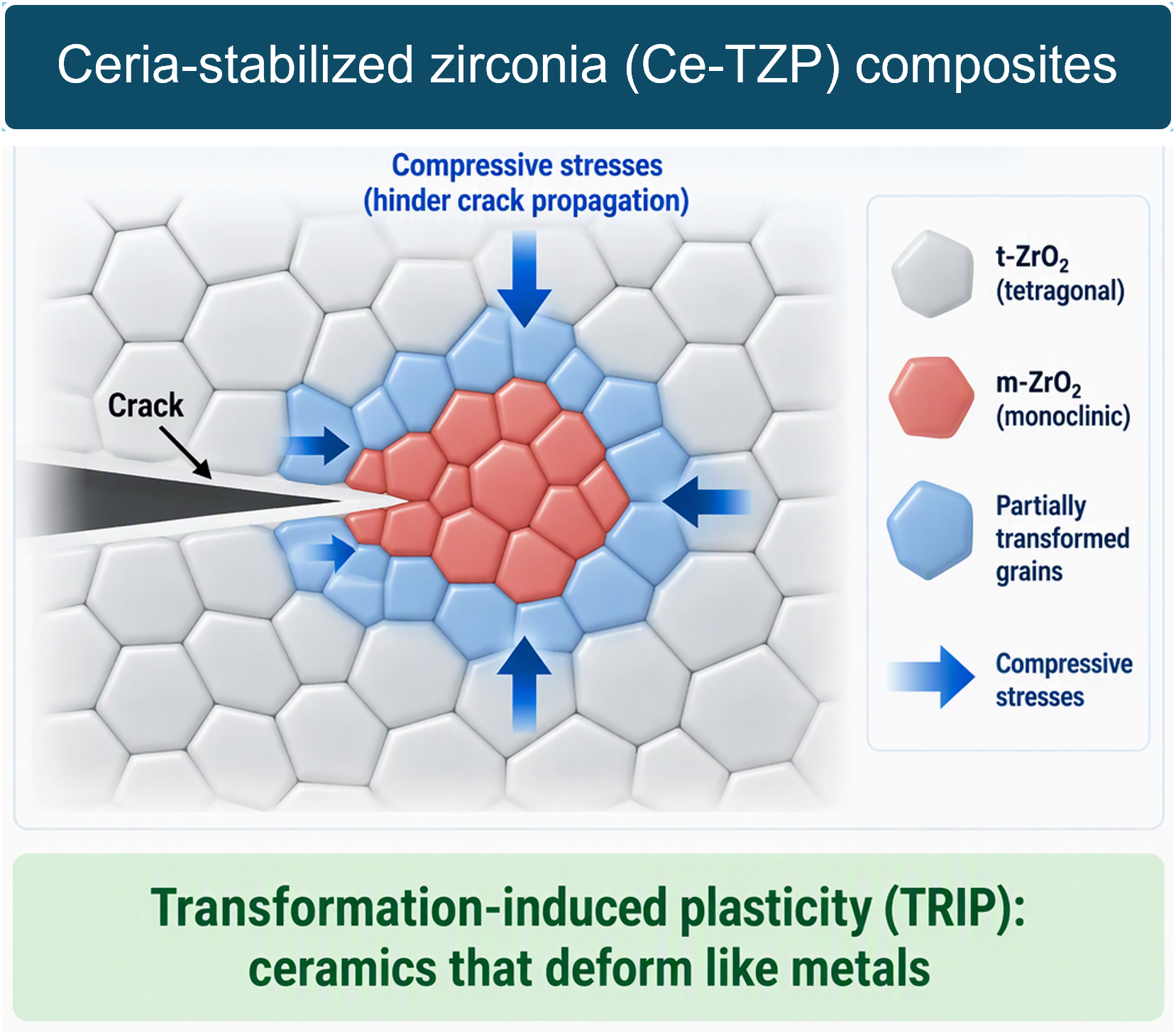
Ceramic implants are generally biocompatible and wear-resistant, but their brittleness makes them sensitive to defects, especially those manufactured by 3D-printing. Ceria-stabilized zirconia (Ce-TZP) composites may offer a promising alternative. Under mechanical loading, the tetragonal zirconia phase transforms into monoclinic phase, which results in an increase in ductility. The ImPatienCe project investigates such transformation-induced mechanisms via in-situ synchrotron X-ray techniques.
Objective

The ImPatienCe project aims to understand the development of tri-phasic Ce-TZP microstructures during processing and their impact on strength, toughness, ductility, and residual stresses. It seeks to optimize stereolithography formulations, processing routes, and thermal treatments, investigate reversible phase transformations, and tailor reliable mechanical properties for additive-manufactured implant applications.
Methods

In ImPatienCe, BAM investigates the formation of strain-induced transformation bands and possible microcracking occurring inside Ce-TZP composites using synchrotron X-ray refraction radiography during in-situ tensile tests. In addition, BAM determines the phase-specific residual stresses and load partitioning between phases using synchrotron X-ray diffraction.

ImPatienCe – Ductile Ceramics for Patient-Specific Implants
Ceramics such as zirconia and alumina are attractive implant materials for many years. They are both biocompatible, safer in terms of metal ion release, and are highly wear-resistant. Their main drawback is brittleness, even small defects, such as those produced by 3D-printing process like stereolithography, can cause sudden failure. Tri-phasic ceria-stabilized zirconia composites offer an attractive solution. Under load, their zirconia grains transform from a tetragonal to a monoclinic crystal structure. This transformation-induced plasticity allows the ceramic to deform before it breaks. In other words, it fosters a ”ductile” behaviour which makes them tolerant to defects. Additionally, heating can reverse the transformation and recover the original shape (shape-memory effect). In the German-French project ImPatienCe, BAM and the MATEIS laboratory (INSA Lyon) investigate how processing, sintering and microstructure control the mechanical behaviour, in both cold isostatic pressed and 3D-printed (stereolithography) ceramics. The results will support the development of reliable patient-specific implants, for example for jaw reconstruction.
Imaging the transformations within the material
Given that optical and electron microscopy only show what happens at the surface, BAM uses synchrotron X-ray refraction radiography (SXRR) at the BAMline of BESSY II. SXRR reveals transformation bands and potential microcracks occurring throughout the tensile loaded samples.
Residual stresses and load partitioning between phases
This tri-phasic ceramic composite consists of zirconia, alumina and strontium aluminate parts. Using the X-ray diffraction, the residual stresses state is measured to examine the influence of process parameters. Additionally, in-situ synchrotron X-ray diffraction during tensile tests are conducted to examine how the load is shared among the phases. Collectively, these results will reveal the critical stress at which the t→m transformation is induced.