


INSAT - Interpretation of NMR signals in partially saturated sandstones based on adsorption theory
Junior research project
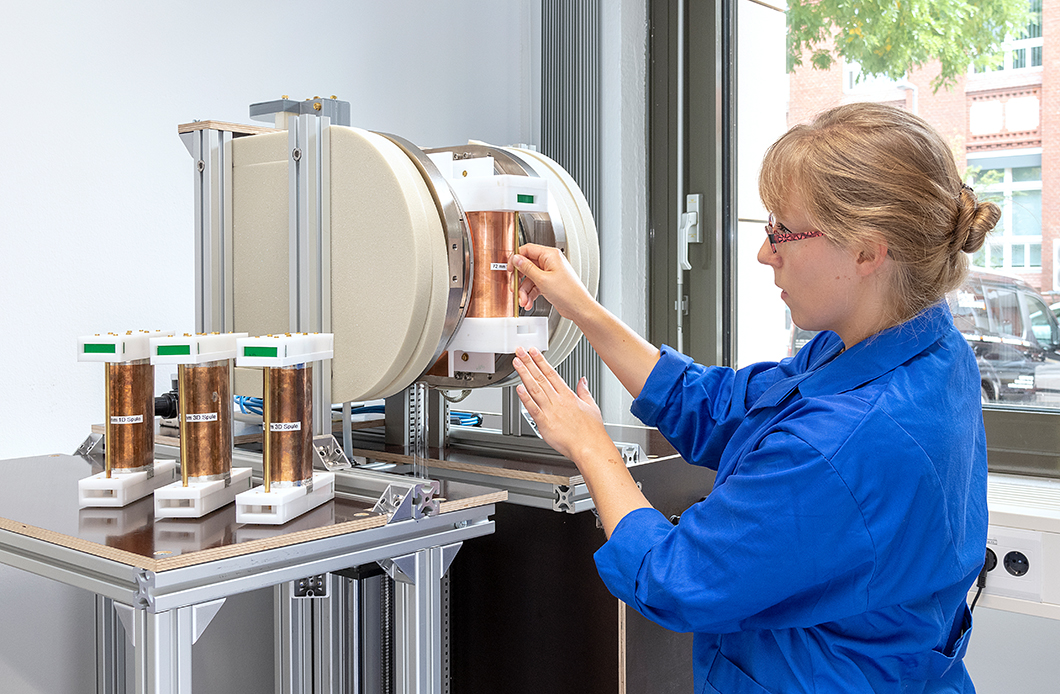
Sarah Munsch working at the NMR tomograph
Description
With this research, a new approach based on adsorption theory shall be developed, that enables the assignment of NMR signals to pore sizes in the case of partial saturation.
Interpretation of NMR signals in partially saturated sandstones based on adsorption theory
The development of environment-friendly and CO2-reduced building materials is nowadays of high interest. However, the hydration mechanisms and durability properties of such new materials require a detailed investigation. 1H NMR seems to be a valuable tool as it enables the non-destructive and in-situ determination of pore space and durability properties such as the mobility of hydrogen protons, porosity and moisture content of the samples. Moreover, at full saturation, NMR signals can be even assigned to pore sizes.
However, when investigating materials during hydration and studying moisture transport processes, the pore systems are usually partially saturated, which makes the interpretation and assignment of NMR signals to pore sizes much more complex. This is due to the fact, that the NMR relaxation time of hydrogen protons in porous materials depends on numerous factors. Besides the molecular bonding, the relaxation behaviour is also influenced by the environment, which means e. g. the pore geometry and the surrounding mineral composition. At partial saturation, the NMR relaxation times are shortened due to two main causes: 1. the moisture is mainly placed in smaller pores (spatial confinement); 2. water films within already partially saturated pores result in short relaxation times due to a stronger bonding to the pore wall. Consequently, short relaxation times may result from two different regimes within one sample and cannot directly be assigned to pore sizes. The difference between full and partial saturation may be seen in the figure below, where the NMR relaxation time distributions at various saturation states are shown.
In order to assign NMR signals of partly saturated systems to pore sizes as well, we currently develop an approach at BAM that is based on adsorption and takes the calculation of the adsorbed water layer thickness into account. For this, samples of 19 different sandstone types were partially saturated by moisture adsorption within desiccators with salt solutions that regulate specific relative humidities. Based on adsorption theory, the adsorbed water amount may be calculated depending on the specific pore-size distribution of a material. This means that for each saturation degree the amount of partially and fully saturated pores can be mathematically calculated. This knowledge then facilitates the interpretation of the according NMR signals measured on partially saturated samples in the lab. The used NMR tomograph at BAM has a high signal-to-noise ratio and allows very short echo times of around 50 µs.
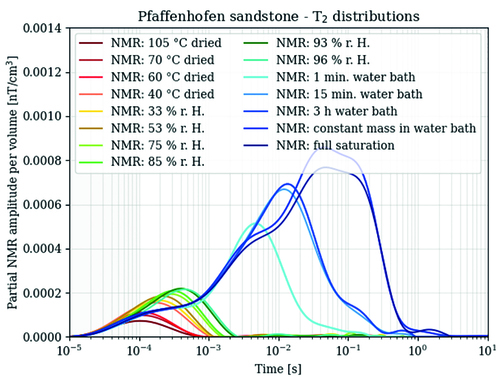
NMR T2 relaxation-time distributions of the Pfaffenhofen sandstone at various saturation states