
Understanding and designing inorganic materials properties based on two- and multicenter bonds (MultiBonds)
Project
MultiBonds
-
Project period
12/01/2025 - 12/31/2029
-
Project type
EU project
-
Project status
Ongoing
Description
A major challenge for the green transition is our inability to rationally design inorganic materials with tailor-made properties. This project will address this problem by improving our understanding of chemical bonding in inorganic materials.
Location
Bundesanstalt für Materialforschung und -prüfung
Unter den Eichen 87
12205 Berlin
Challenge
MultiBonds
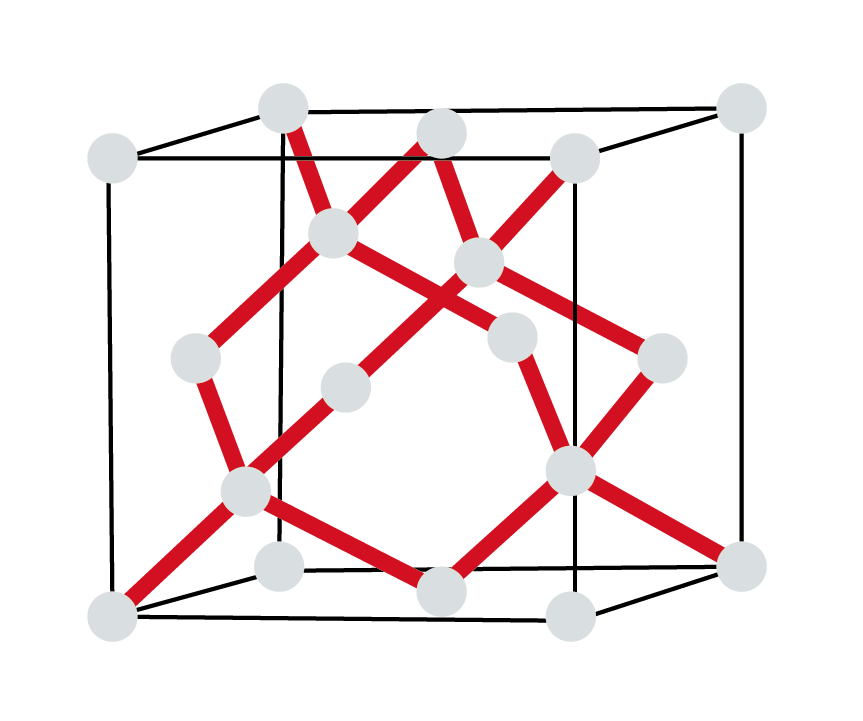
Understandable rules based on chemical bonding have greatly advanced chemistry but are lacking for most material properties, severely limiting the rational design of materials. Until recently, quantum chemical bonding analysis of inorganic materials has only been performed on a small scale, making it impossible to derive such rules using machine learning. Moreover, quantum chemical bonding analysis mainly focuses on two-centre bonds. However, multi-centre bonds play a crucial role for material properties: for example, for the superhardness of boron-containing compounds.
Objective

The overarching goal of MultiBonds is to derive universal rules for inorganic material properties based on chemical bonding.
We will 1) develop and apply innovative automated quantum chemical methods to calculate multi-center bonding indicators on a large scale for the first time. The generated database will then be used for 2) the development of novel predictive deep learning models and 3) intuitive, human-understandable rules for material properties.
Methods

This project will develop automation methods for the calculation of chemical bonding indicators. We will build on our previous developments in the automation software atomate2 and LobsterPy. These tools have been developed as part of the publication database of bonding indicators for two-center bonds, which served as a pilot study for this project. To develop rules for materials properties based on chemical bonding, state-of-the-art machine learning methods will be used as well.
Partners

Project coordination: Bundesanstalt für Materialforschung und -prüfung (BAM)
Funding: The project receives funding from the European Research Council (ERC)
Funding
Project MultiBonds (grant agreement Nº 101161771) is being supported by an ERC Starting Grant, funded by the European Union. Views and opinions expressed are however those of the author(s) only and do not necessarily reflect those of the European Union or the European Research Council Executive Agency. Neither the European Union nor the granting authority can be held responsible for them.