

One Year of Microplastics in the River Rhine – Tracing the invisible
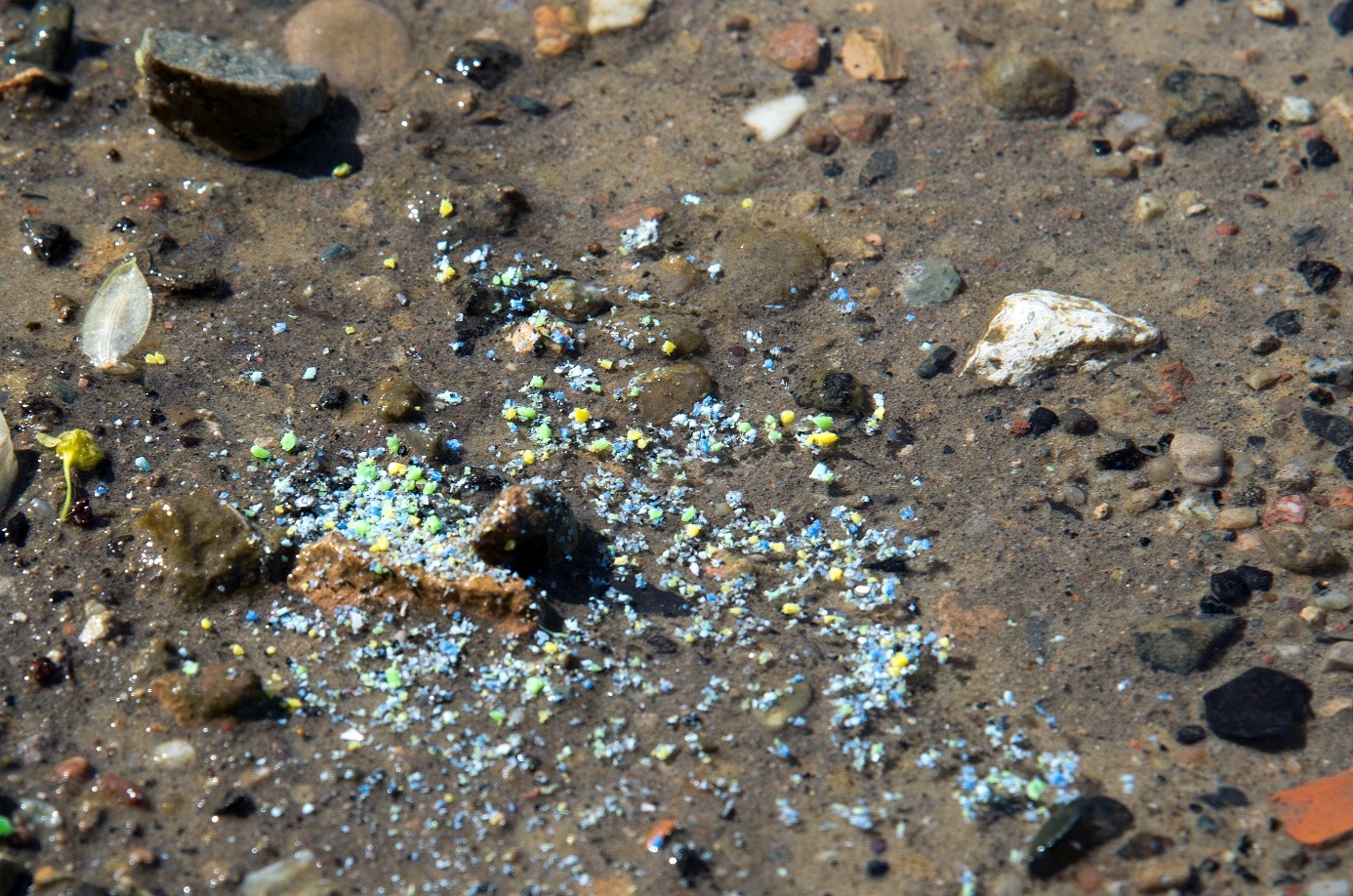
Foto am Flussufer mit Mikroplastik
Although the topic of microplastics has been intensively researched for over 10 years, many questions remain unresolved to this day. In addition to questions about possible health risks, this also concerns the identification of sources, transport pathways, and their abundance in the environment. Reliable datasets are lacking. Only by identifying microplastic sinks and their concentrations can targeted mitigation measures be implemented and toxicological studies conducted using environmentally relevant levels.
The situation is further complicated by the fact that micro- (1–1000 µm) and nanoplastic (< 1 µm) particles are generally invisible to the human eye and highly heterogeneous. They vary in size, shape, density, and chemical composition. Moreover, microplastics are difficult to distinguish from natural particles, which necessitates precise and complex laboratory techniques.
Rivers are often sinks for microplastics, making it essential to understand their dynamics. Microplastics enter rivers from various sources, such as tire abrasion, plastic degradation, and industrial and domestic wastewater. These inputs vary significantly throughout the year, influenced by precipitation, flood events, discharge volumes, temperature, and tourist and industrial activities. Another challenge is spatial variability: flow conditions, sedimentation, and point-source discharges lead to an uneven distribution of particles.
Short-term studies therefore often provide only snapshots that do not reflect the full extent of contamination. Continuous monitoring over twelve months allows for a more precise identification of trends, peak loads, and potential sources. In addition, interactions between environmental conditions and microplastic concentrations can be analyzed. This forms an important basis for effective measures to reduce inputs as well as for political decision-making in water protection. A long-term dataset also helps to better understand impacts on ecosystems and to establish reference values for future studies.
The present study shows the microplastic contamination of the Rhine River over a one-year period. Samples were collected monthly at the sites Weil, Koblenz, and Emmerich using a sedimentation box, separated into three size classes by sieving, and microplastic concentrations were measured using TED-GC/MS. The samples were then evaluated with regard to polymer type, size, and their seasonal and spatial distribution.
One Year Observation of Microplastic Concentrations in the River Rhine
Yosri Wiesner, Paul Eisentraut, and Korinna Altmann
ACS ES&T Water, 2026