


Six-Seven: Lithium's isotopic fingerprint makes battery aging visible
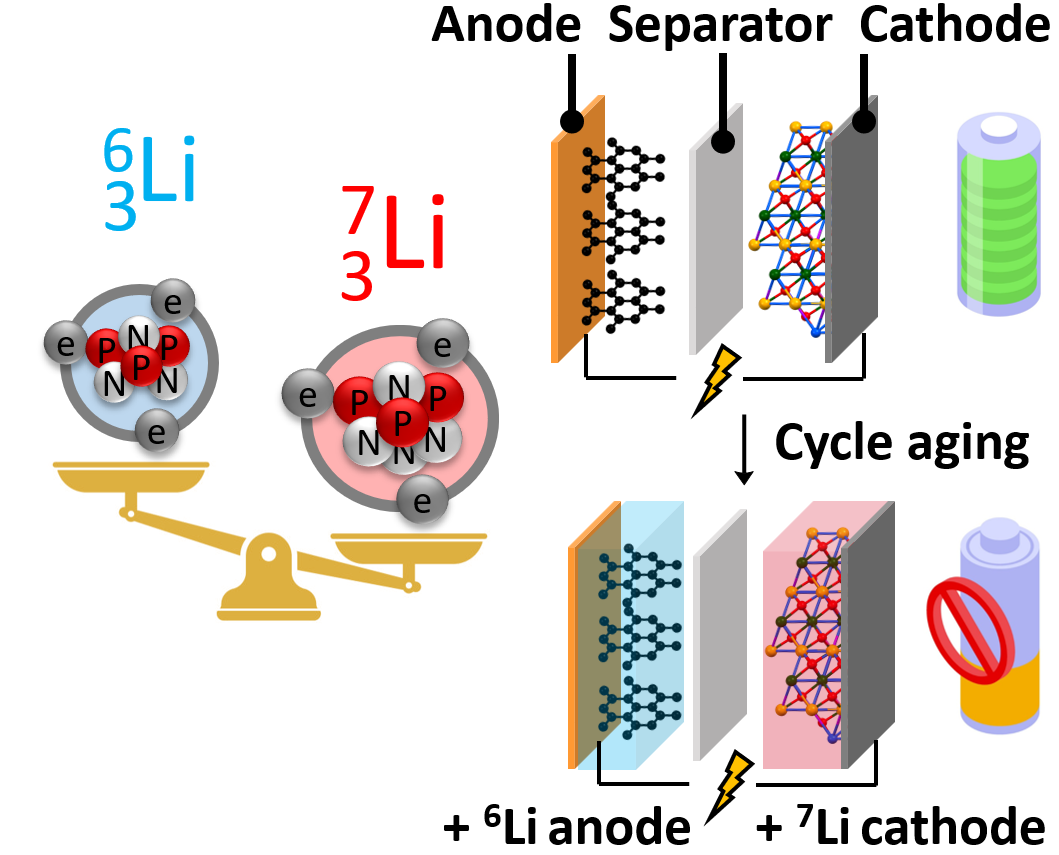
Lithium-ion batteries power electric vehicles and store electricity from renewable sources. However, they gradually lose capacity during use. To develop longer-lasting batteries, it is necessary to understand what happens to lithium inside a cell as it is repeatedly charged and discharged.
Lithium exists naturally as two stable isotopes, which are atoms of the same element with nearly identical chemical behavior but slightly different masses: lithium-6 and lithium-7. This small difference can affect how they move through the battery and where they become trapped.
Inside a lithium-ion battery, lithium ions shuttle between electrodes during charging and discharging, a process known as cycling. In an ideal system, both isotopes would behave identically. However, real batteries are highly heterogeneous environments in which reactions occur at interfaces, transport is rapid, and thin interphases continuously form and evolve. Under these conditions, even small mass differences can influence transport and trapping processes.
Here, lithium isotopes are used as natural tracers to probe internal processes during battery operation. Instead of adding external labels, the lithium isotope ratio is measured at different depths within the electrodes.
The study examined commercial battery materials consisting of a nickel–manganese–cobalt cathode and a graphite anode. The batteries were investigated before and after repeated charging and discharging, and at different charging rates.
Before cycling, the isotopic composition was uniform, indicating no isotopic separation. After cycling, however, a clear redistribution was observed: the heavier isotope became enriched in the cathode, while the lighter isotope accumulated near the surface of the anode. This demonstrates that measurable isotope fractionation occurs during battery operation. The extent of separation depended on the charging rate, showing that kinetics influences lithium transport and trapping. Notably, the isotopic patterns correlated with capacity loss over time, linking isotope distribution to electrochemical degradation.
These signatures are especially informative about processes at electrode surfaces, where reactive interphases form and evolve during cycling and strongly influence capacity fade. This work establishes a link between local lithium isotope composition, interphase development, and degradation mechanisms, offering a diagnostic view of how performance losses develop over time.
Depth-Resolved Lithium Isotope Fractionation as a Diagnostic of Interphase Evolution and Degradation in Lithium-Ion Batteries
Beatrice Battistella Adam Revill, Cornel Venzago, Volker Hoffmann, Leonardo Agudo Jácome, Dominik Al-Sabbagh, Sebastian Recknagel, Carlos Abad
ACS Energy Letters, 2026