
HICON – Hydrogen Ignition Control Experimental Campaign 3: Mechanical Impacts
Project
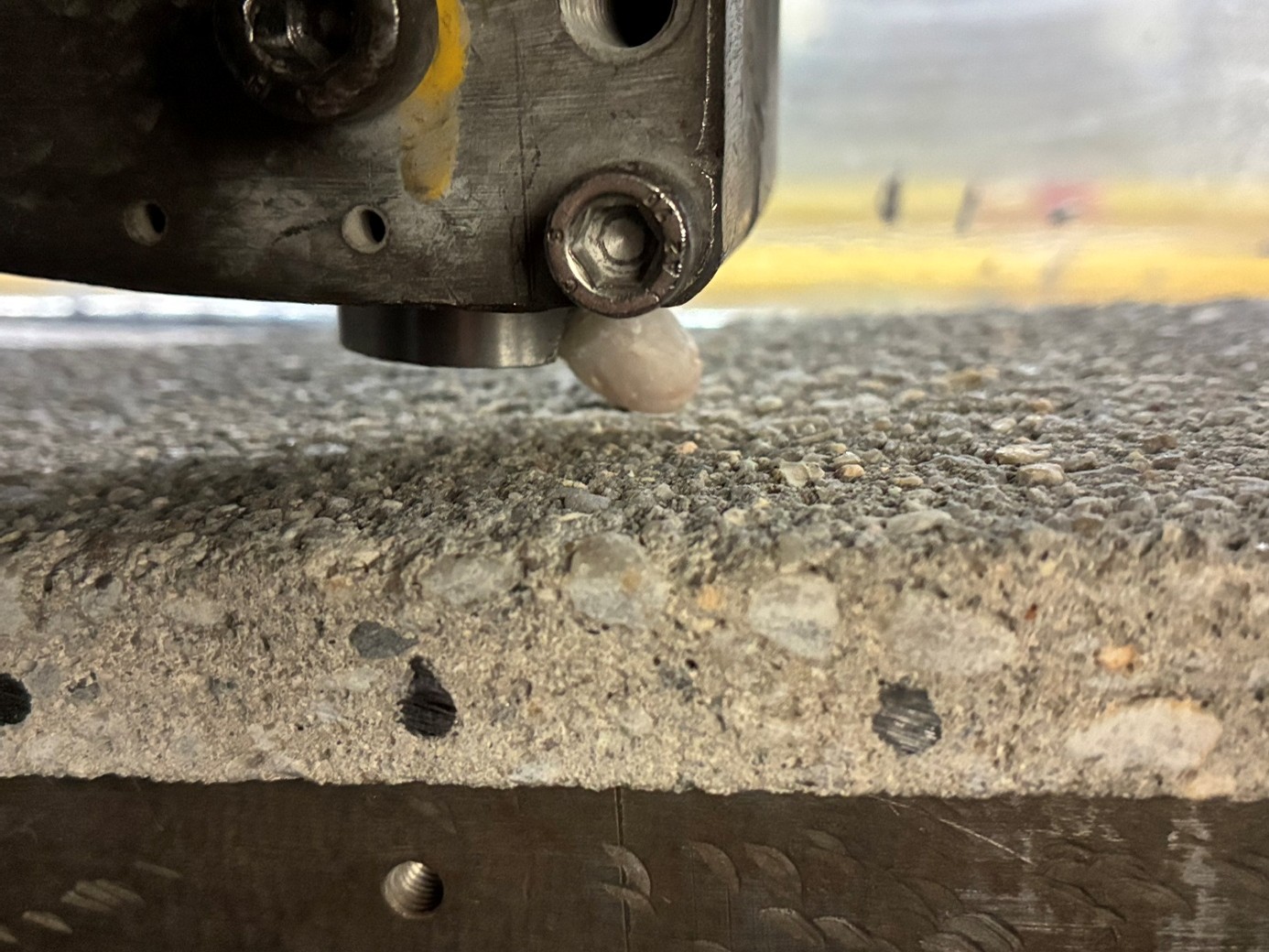
Lever with a quartz-rock impact pin on a concrete impact plate with embedded quartz rocks, prior to an impact test in the spark-ignition apparatus using an explosive gas mixture of hydrogen and air, to investigate the ignition effectiveness of the mechanical impact.
Description
As part of the project, experiments are being conducted to establish a valid database for the statistical assessment of the effectiveness of potential ignition sources under realistic conditions, and to gain a better understanding of the various influencing factors. The results are intended to be used to adapt existing risk models for natural gas installations to hydrogen installations.
Challenge
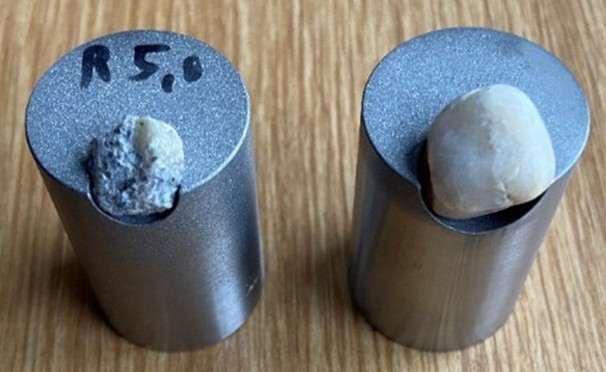
Prepared test specimens for determining the ignition probability of gas mixtures during impact events: a rock-impact pin.
Mechanical impact events are among the most significant ignition sources in potential real-world explosion incidents, particularly in the case of hydrogen facilities. The project experimentally investigates the ignition effectiveness of this ignition source. The focus of the investigations is on impact events involving rocks and entrained gravel, as well as contaminated surfaces, e.g. those covered with oils or sand. The results enhance our understanding of mechanically generated sparks as ignition source and support the transfer of corresponding risk models for natural gas facilities to hydrogen facilities.
Objective

The aim of the project is to establish a database that will enable the ignition effectiveness of impact events to be assessed for material combinations that have been little studied to date but are relevant in practice. This will allow measures to be taken during the risk assessment of hydrogen facilities to prevent impact events involving specific materials and, where necessary, to adapt risk models for hydrogen facilities.
Methods
Special test specimens are being developed to enable reproducible and comparable impact tests on rocks and contaminated surfaces. Using these test specimens, the relative frequencies of ignition are determined experimentally in an impact spark apparatus, and the ignition effectiveness of various combinations is statistically evaluated. On this basis, it is possible, on the one hand, to make qualitative assessments regarding unsuitable materials and, on the other hand, to support the adaptation of existing quantitative risk models.
Partners

The HICON project is funded by the Research Council of Norway. As part of this research project, the project consortium represented by the project owner Safetec Nordic AS commissioned the Federal Institute for Materials Research and Testing (BAM) to lead the sub-project ‘Experimental Campaign 3 – Mechanical Impacts’.
Risk models that are well-established in the oil and gas industry, based on many years of experience and empirical data, need to be adapted so that they can be applied to hydrogen applications. The HICON (‘Hydrogen Ignition Control’) project aims to experimentally investigate relevant ignition mechanisms for hydrogen in order to better understand the conditions and influencing factors for effective ignition, to be able to capture ignition probabilities in risk models more accurately, both quantitatively and qualitatively, and to implement suitable protective measures.
The BAM sub-project “EC 3: Mechanical Impacts” focuses on mechanical impact as a source of ignition. In earlier work, mechanical impact was investigated primarily in the context of industrial explosion protection. For example, the influence of different material combinations on ignition effectiveness during mechanical impact was examined in order to identify suitable materials that generate few sparks for use in potentially explosive atmospheres. The focus was therefore primarily on homogeneous metallic material combinations.
When assessing ignition probabilities in risk models, it is particularly important to take into account mechanical impacts with objects located outside potentially explosive atmospheres.
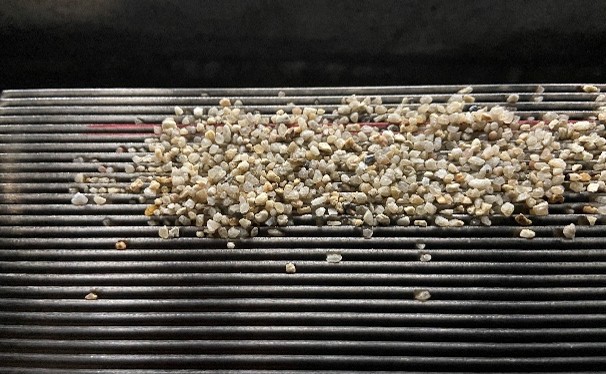
Prepared test specimens for determining the ignition probability of gas mixtures during impact events: an impact plate coated with quartz sand
Aims and work packages:
As part of the HICON sub-project EC 3, mechanical impact processes involving material combinations that have not been extensively studied to date, but which may well occur under real-world conditions during accidents, are being investigated experimentally. Firstly, the ignition probabilities during impact processes involving various types of rock – which may occur in industrial practice, for example when gravel beds are stirred up – are being determined. Secondly, the influence of contaminated surfaces (e.g. with oil or sand), which cannot always be ruled out in practice, on ignition probabilities during mechanical impact is being investigated.
Special test specimens (impact pins, impact plates, etc.) are manufactured for the experimental investigations and can be installed in an impact spark testing apparatus. The impact spark apparatus enables the generation of reproducible mechanical impacts with a defined kinetic impact energy within a closed chamber, which can be filled with any gas mixture. Due to the increased effort involved in using the specially manufactured test specimens, limiting the number of tests whilst ensuring the statistical validity of the results presents a particular challenge.
The results enable a qualitative comparison of various influencing factors and are to be used by the project partners to further develop existing risk models.
Partners:
Safetec Nordic AS (Project lead), Proactima AS, Vysus Norway AS, Equinor Energy AS, Gassco AS, Gen2 Energy AS, Vår Energi ASA, Aker Horizons Asset Development AS, Yara Clean Ammonia Norge AS, DSB
Funding
The HICON project is funded by the Research Council of Norway (project number 346627). The Federal Institute for Materials Research and Testing (BAM) has been commissioned by the project consortium to carry out the sub-project ‘Experimental Campaign 3 – Mechanical Impacts’.