
nanoPlattform -Reference nanomaterials, reference procedures, reference data
Project
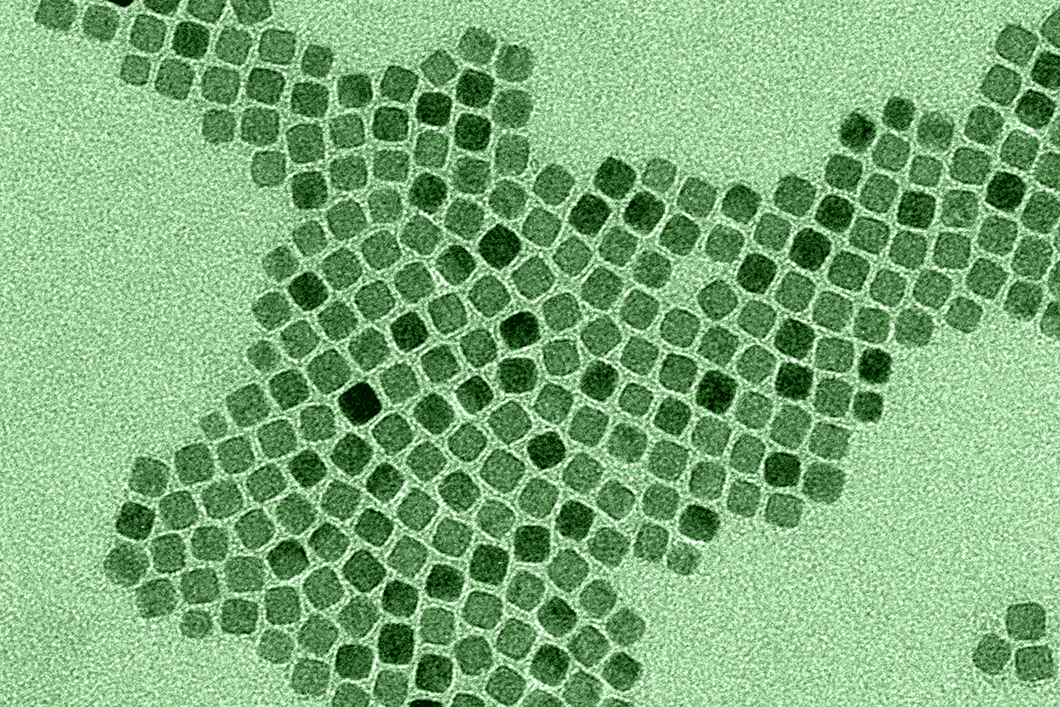
The first reference material from the nanoPlattform project: the particles consist of iron oxide, are cubic and have an edge length of approx. 8 nm
-
Project period
06/01/2020 - 05/21/2023
-
Project type
BAM project
-
Project status
Closed
Description
Within the nanoPlattform project, new nano reference materials are being produced and methods for characterising nanomaterials are being standardised and further developed. In addition, a digital basis is being created to simplify and standardise the recording of measurement results.
Location
Bundesanstalt für Materialforschung und -prüfung
Unter den Eichen 87
12205 Berlin
Challenge
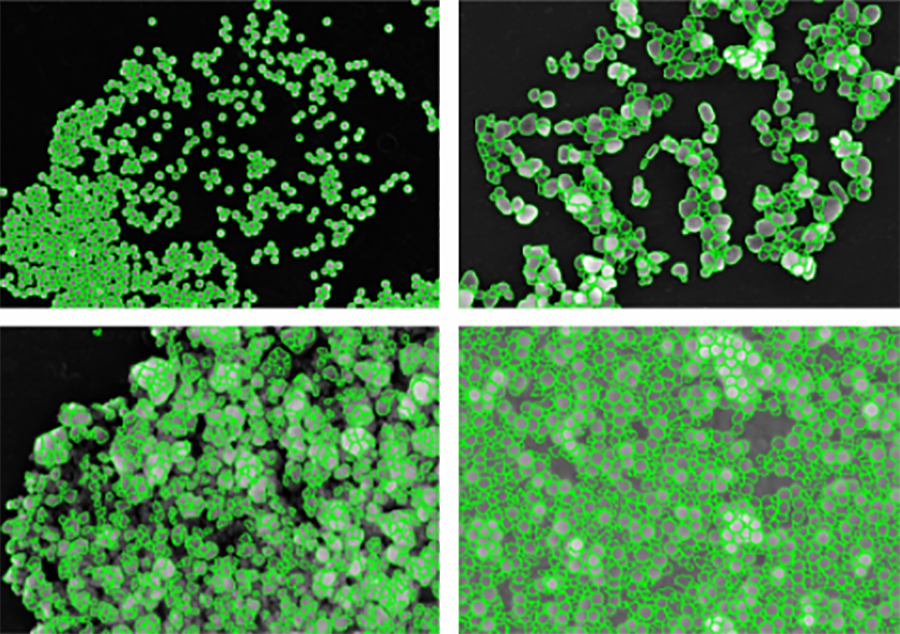
Particles of Au, TiO2, BaSO4, SiO2, FeOx imaged with different techniques (SEM, eSEM, TEM) and their segmentation masks
The provision of reference materials, reference methods and reference data is a core task for BAM. The most important aspect of this task is to improve the comparability of physicochemical characterisations and toxicological tests. Within the framework of the nanoPlattform project, new reference materials in the nanoscale range are being developed, characterisation methods for nanomaterials are being standardised and coordinated, and reference data for nanomaterials are being defined and made available.
Objectives

The project aims to combine BAM's resources in the field of nanomaterials, to allow for new possibilities, to simplify and to standardise processes. In addition to the production of new reference materials, standardised, quality-assured reference procedures for the characterisation of nanomaterials are to be established. Another important goal of the project is the establishment of digital interfaces for the characterisation of nanomaterials.
Methods

Nanomaterials are considered from five perspectives in the project:
The materials and their production - the dispersion of the nanoparticles - the application of the characterisation methods - the automated recording of the results and uncertainties - the validation and quality assurance of the results. By taking a comprehensive view of the processes, sources of error are quickly recognised, well identified and documented.
Partners

Partners
9 BAM divisions
Funding
The nanoPlattform project is funded by BAM.
Nano reference materials
Available certified nano reference materials are usually idealised nanomaterials, i.e. materials which are optimally spherical, have a uniform size and consist of only one material. These ideal nanoparticles are easy to characterise and are often used for calibration purposes. However, most nanomaterials do not usually have ideal properties. It is a major goal of the nanoPlattform project to provide approximately real nanoparticles, especially non-spherical nanoparticles with well-defined surface properties.
Nano reference methods
Many methods for characterising nanomaterials are well established. However, many nanomaterials often have one or more properties that complicate the application of certain methods or completely prevent the application of a method. These properties include, for example, agglomeration behaviour, porosity and materials that are not detectable for a measurement method or will be influenced by the measurement method. For example, radiation damage in the electron microscope is often negligible for particles in the µm range, whereas in the nanometer range this can result in a significant change of the material.
The aim of the nanoPlattform project is to combine the measurement methods with the corresponding methods for sample preparation, while also clearly addressing the limitations of each method.
Nano reference data
Reproducible data sets and referenceable algorithms and operating procedures are considered reference data. Reference data can be made available in a variety of ways. However, this is not the focus of the nanoPlattform project. The project developes the process of creating quality-assured reference data. Reference data of nanomaterials are usually based on reference materials that have been characterised with reference methods. The aim of the project is to create automated processes to generate well-documented reproducible and quality-assured reference data. For this purpose, the characterisation results must be stored permanently and also versioned as reference data, e.g. in form of standard operating procedures. This reliable acquisition, storage and conflation of data is being conceived within the framework of the nanoPlattform project and established as a process at BAM.
First results
New reference material: iron oxide nanocubes
The first reference material from the nanoPlattform project has passed the homogeneity tests and is expected to be available as a reference material in the BAM webshop in mid-2022. The particles consist of iron oxide, are cubic and have an edge length of approx. 8 nm. The exact data will be listed in the certificate.
Algorithm for the automatic marking of nanoparticles on electron microscope images
A first draft of an algorithm for the automatic labelling of particles on electron microscope images has been created and is being continuously developed. The algorithm uses artificial intelligence (artificial neural networks) to autonomously recognise the nanoparticles on the image and can automatically evaluate the following parameters for cubic nanoparticles, for example:
- Minimum Feret diameter
- Shortest edge
- Longest edge
- Aspect ratio
- Equivalent cross-sectional area of a particle
- Circumference of a particle
- Proportion of incomplete particles
- Shape factors
- Size distribution
- The algorithm is under continuous development and is available on BAM's Git server
Partners
The following BAM divisions contribute to the project:
Inorganic Trace Analysis: spICP-MS -- Single particle mass spectrometry with inductively coupled plasma
Biophotonics: PTA -- Particle Tracking Analysis, NTA -- Nanoparticle Tracking Analysis, AFM -- Atomic Force Microscopy
Structure Analysis: DLS -- Dynamic Light Scattering, SAXS -- Small Angle X-ray Scattering
Materials and Air Pollutants: characterisation process, DMAS -- Differential Mobility Analysis System
Materialography, Fractography and Ageing of Engineered Materials: TEM -- Transmission Electron Microscopy
Advanced Technical Ceramics: dispersion methods, CLS -- Centrifugal Liquid Sedimentation Analysis, DLS -- Dynamic Light Scattering, VSSA -- Volume Specific Surface Area
Surface Analysis and Interfacial Chemistry: SEM -- Scanning Electron Microscopy , XPS -- X-ray Photoelectron Spectroscopy
Synthesis and Scattering of Nanostructured Materials: SAXS -- Small Angle X-ray Scattering
Tribology and Wear Protection: AFM -- Atomic Force Microscopy
Funding
The project is funded by BAM.
Find further information on nanotechnology on Centre of Competence AdvancedMaterials@BAM