

TG-PSD - OECD test guideline on the particle size distribution of manufactured nanomaterials
Project
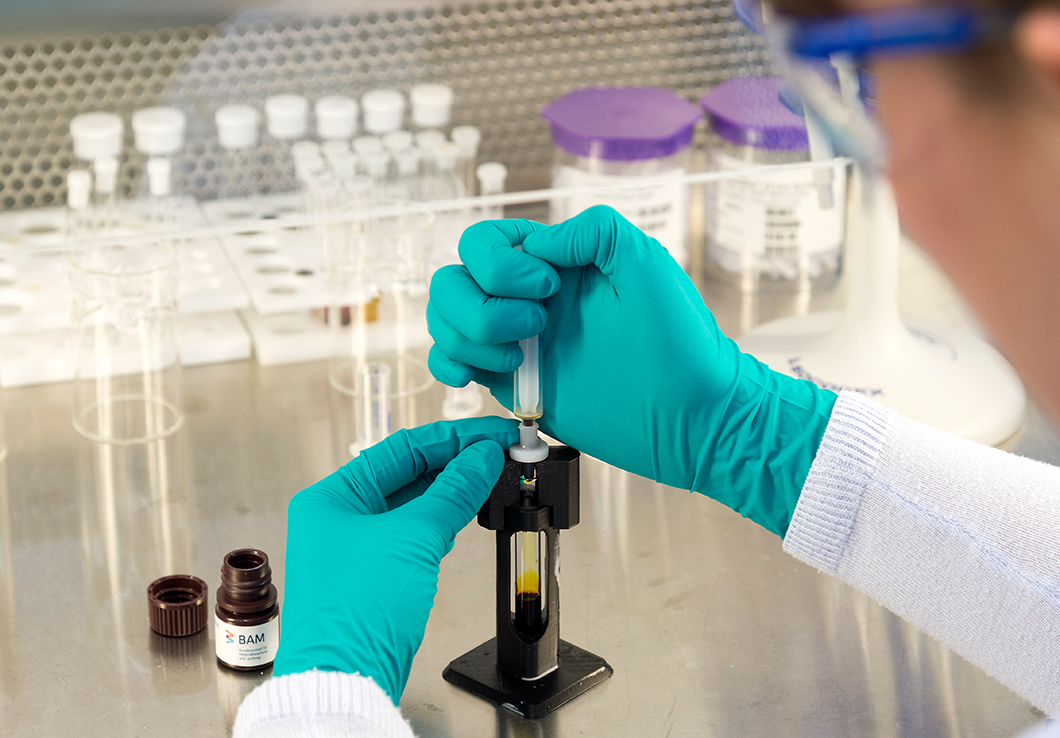
Sample preparation for the measurement with SAXS
-
Project period
05/05/2017 - 05/04/2020
-
Project type
Interdisciplinary project
-
Project status
Closed
Description
The aim of the project is the development of a harmonized test guideline for a valid and reproducible determination of particle size and size distribution of nanomaterials.
Location
Bundesanstalt für Materialforschung und -prüfung (BAM)
Richard-Willstätter-Straße 11
12489 Berlin
Description
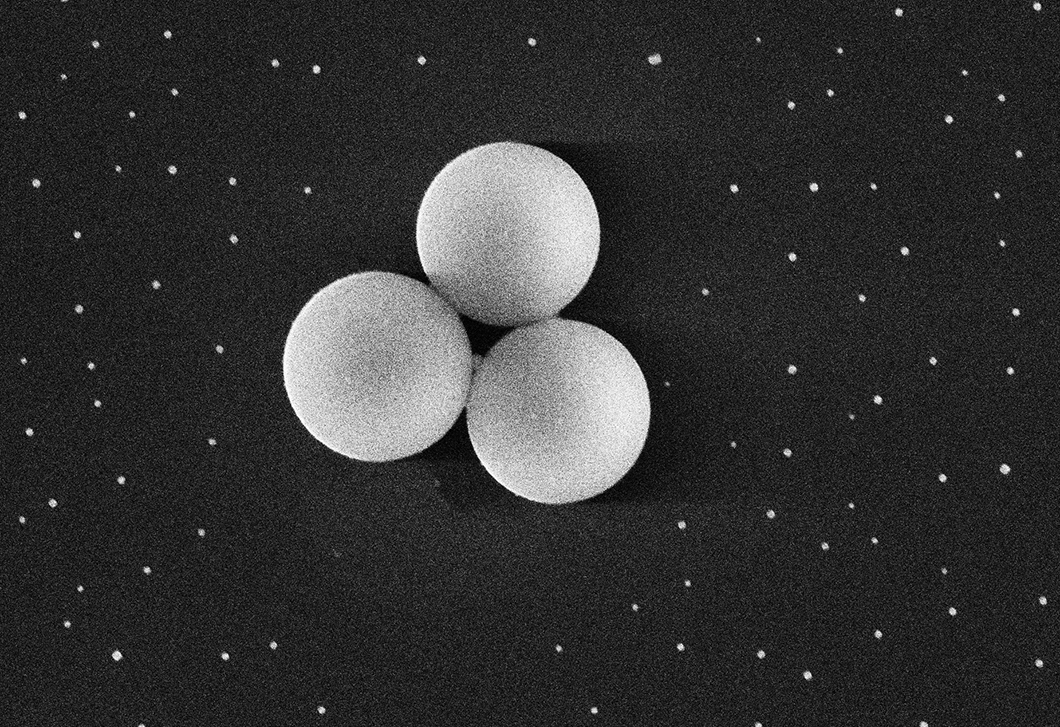
Nanoparticles surround three 1 µm particles.
The OECD Test Guideline "Particle Size Distribution / Fiber Length and Diameter Distributions" is to be supplemented by a new test guideline for nanomaterials. Germany will develop the supplement to this Directive. The Bundesanstalt für Materialforschung und -prüfung (BAM) and the Federal Institute for Occupational Safety and Health (BAuA) were commissioned to do so.
Objectives

The aim of the project is the development of a harmonized OECD test specification for a valid and reproducible determination of particle size and size distribution of nanomaterials.
Methods

For size characterization of nanoparticles BAM uses the following measuring methods:
- Transmission electron microscopy (TEM),
- Scanning electron microscopy (SEM)
- Differential mobility analysing system (DMAS)
- Dynamic light scattering (DLS)
- Centrifugal liquid sedimentation (CLS)
- Particle tracking analysis (PTA)
- Atomic force microscopy (AFM)
- Small angle X-ray scattering (SAXS) Single particle induced coupled plasma mass spectrometry (spICP-MS)
Partners

Partners
Bundesanstalt für Materialforschung und -prüfung (BAM)
Bundesanstalt für Arbeitsschutz und Arbeitsmedizin (BAuA)
TG-PSD – Development of a specific OECD test guideline for the determination of particle size and particle size distribution of manufactured nanomaterials
In 2006, the OECD initiated a sponsorship program for the testing of nanomaterials, in which several nanomaterials were thoroughly investigated using a variety of methods. One of the goals of the sponsorship program was to find out where problems occur and where there are gaps in the measurement and test procedures or if changes are required. An important outcome of the sponsorship program was the finding that the OECD testing guidelines should in many cases be adapted to the testing of nanomaterials. The existing standardized test methods of the OECD for physical-chemical characterization were not developed for nanomaterials in particular. An important first adaptation concerns the test guideline for sizing.
Germany complied with the request of the OECD in 2017 and has agreed to supplement the "Particle Size Distribution / Fiber Length and Diameter Distributions" test guideline for nanomaterials. The BAM and the Federal Institute for Occupational Safety and Health (BAuA) were commissioned with the development of the test guideline, whereby the BAM is responsible for the size characterization of nanoparticles and the BAuA is responsible for the size characterization of the nanofibers.
Background
Different measurement methods often yield similar but slightly different particle size distribution results. This is caused by different measurement principles of the methods. Each method measures a specific parameter from which the particle size is calculated. However, the individual parameters are influenced by the structure and material of the particles. If two different methods are used to measure, they might result in two different particle size distributions, which are nevertheless both correct. Further metrological problems can be found in the dossier for size determination of nanomaterials.
The different results of the measurement methods might be problematic, but in part also desirable because they can reflect different physical properties of the particles. Specific properties of the respective nanoparticles in different media (water, air ...) can be addressed by choosing the correct measurement method. One example is the inhalable fraction of airborne particles (aerosols) in the lungs. For the specific case the so-called aerodynamic equivalence diameter has to be determined. For the color of quantum dots, however, the geometric diameter of the metal core is crucial.
Methods
In the test guideline for the size characterization of nanoparticles, the focus will be on the commonly used methods. These are currently the methods:
- Transmission electron microscopy (TEM)
- Scanning electron microscopy (SEM)
- Differential mobility analysing system (DMAS)
- Dynamic light scattering (DLS)
- Centrifugal liquid sedimentation (CLS)
- Particle tracking analysis (PTA)
- Atomic force microscopy (AFM)
- Small angle X-ray scattering (SAXS)
- Single particle induced coupled plasma mass spectrometry (spICP-MS)
The methods react differently to different materials. Each of the listed methods requires special expertise and, in particular, a well-founded expert knowledge when creating a test guideline. This in-depth expert knowledge is available at BAM. Many departments of BAM are involved in the work. For questions about the individual methods, please contact the listed contact persons of the specialist areas mentioned.
Partners
BAuABundesamt für Arbeitsschutz und Arbeitsmedizin: Nanotechnologie The Federal Institute for Occupational Safety and Health (BAuA) is working on the project for the size characterization of nanofibers.
The Bundesanstalt für Materialforschung und -prüfung (BAM) is working on the project for the size characterization of nanoparticles
The following departments of BAM contribute to the work:
Inorganic Trace Analysis: sp ICP-MS
Biophotonics: NTA u. AFM
Structure Analysis: DLS
Materials and Air Pollutants: DMAS
Materialography, Fractography and Ageing of Engineered Materials: TEM
Advanced Technical Ceramics: CLS u. DLS
Surface Analysis and Interfacial Chemistry: REM
Polymers in Life Sciences and Nanotechnology: SAXS und FFF
Nanotribology and Nanostructuring of Surfaces: AFM
Funding
The project is funded by the Federal Ministry for the Environment, Nature Conservation and Nuclear Safety (UBA) under grant number FKZ3717664150 in the “Ressortforschungsplan” of the Ministry of Environment (BMU).